A breakthrough study by researchers at the Chengdu University of Technology has shed new light on the environmental conditions that existed during a critical period in Earth’s history—the late Ediacaran Period (approximately 551–533 million years ago). The research, published in the journal Global and Planetary Change, provides compelling evidence that the oceans of that time contained a much smaller reservoir of bioavailable phosphorus than modern seas. This finding offers a fresh perspective on the nutrient constraints that may have influenced the dawn of complex animal life.
Research Background: A Pivotal Epoch for Life
The late Ediacaran Period was a time of profound biological innovation, witnessing the first appearance of mobile animals, bilateral body plans, and early biomineralization. Phosphorus is a key nutrient essential for all life and is often the ultimate limiting factor for biological productivity in the oceans. Understanding its availability is therefore crucial for unraveling the complex interplay between environmental change and the explosive diversification of life that characterized this era. However, direct evidence for phosphorus levels in ancient oceans has been scarce, leaving a significant gap in our knowledge.
Key Findings: A Sparse Nutrient Landscape
To address this, the research team, led by PhD student Yonghan Fan under the supervision of Pro. Chao Li, applied an innovative geochemical proxy—Carbonate-Associated Phosphate (CAP)—to well-preserved sedimentary rocks from the terminal Ediacaran. Analyzing samples from ancient continental shelves in present-day Namibia and South China (see Fig.1), the study consistently found very low CAP ratios . This indicates that the concentration of dissolved inorganic phosphorus, a key form readily used by organisms, was remarkably low in the shallow oceans where early animals lived.
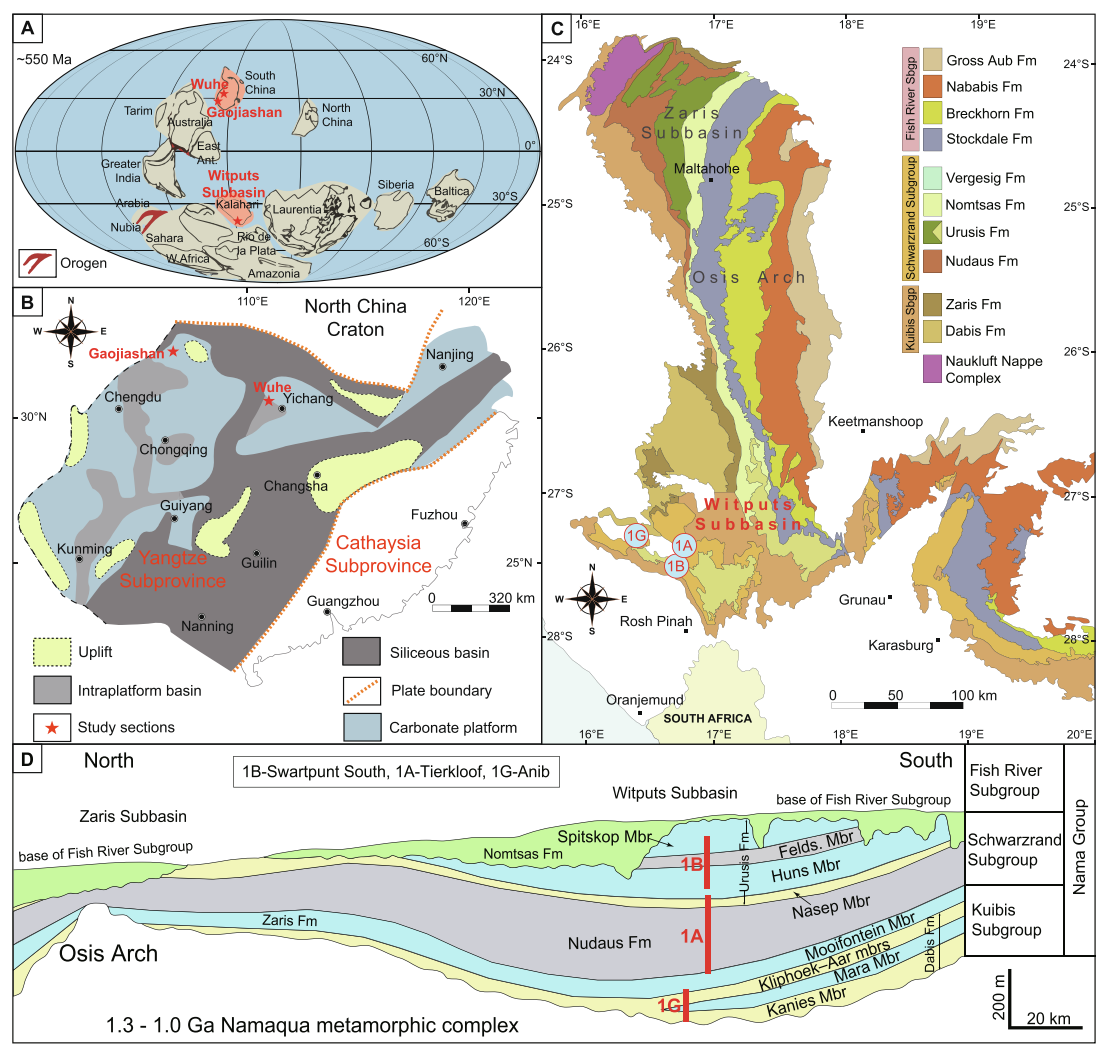
Figure 1. Location of study sections and stratigraphic correlation. A. Paleogeographic reconstruction of the late Ediacaran (~550 Ma), showing study locations in Namibia (Kalahari Craton) and the South China Craton. B. Lithofacies paleogeographic map of the South China region. C-D. Geological map and schematic vertical stratigraphic distribution of the Nama Group in Namibia
Methodology and Robust Conclusions
The researchers conducted a thorough analysis to ensure their findings were not skewed by other geological processes. They carefully accounted for potential influences such as the release of iron-bound phosphorus and rock alteration (dolomitization). Even after considering these factors, the CAP values remained persistently low, leading to the robust conclusion that the late Ediacaran ocean's inorganic phosphorus reservoir was intrinsically small (see Fig. 2). This scarcity of a vital nutrient suggests that, contrary to some previous views, the oceans were not highly productive, despite other evidence for dynamic environmental changes.
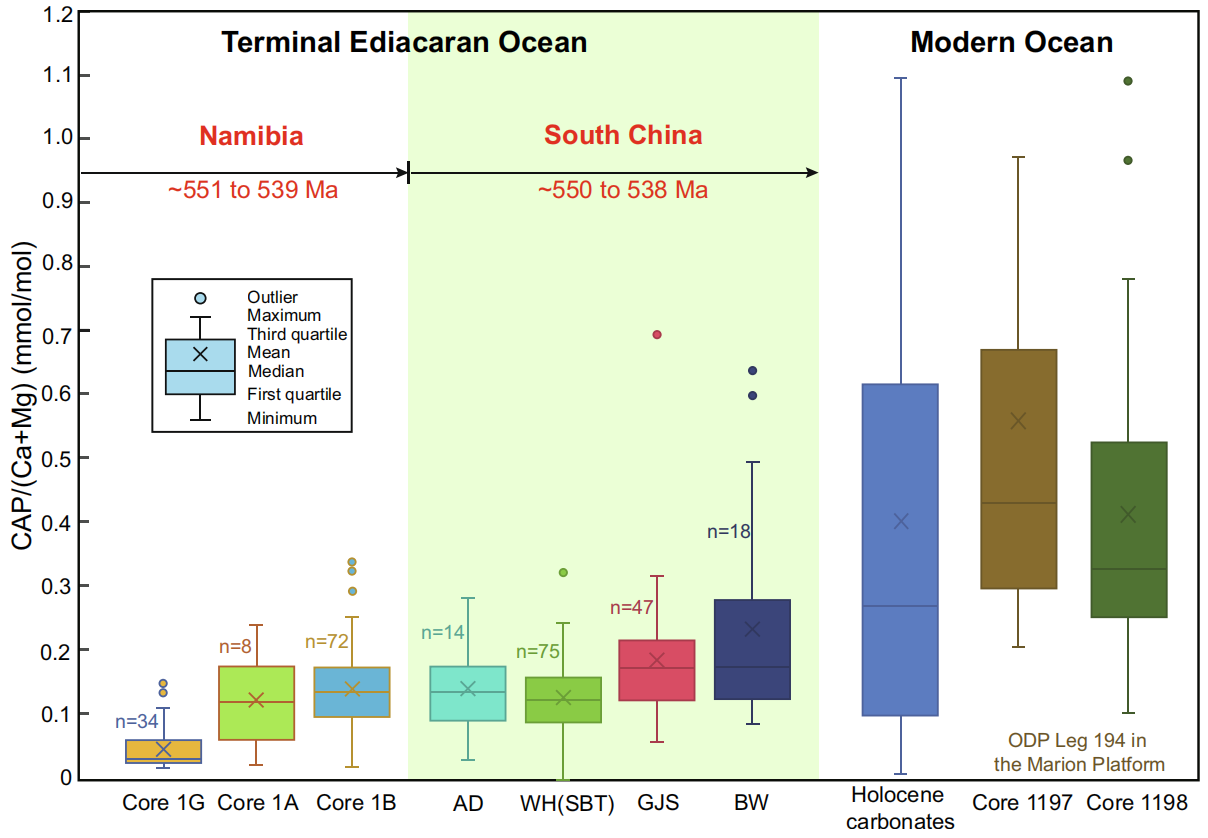
Figure 2. Comparison of late Ediacaran CAP data with CAP values from modern marine carbonate rocks. All data from this study ("Terminal Ediacaran Ocean") fall within the lower range of the distribution plot, clearly supporting the core conclusion of "a small-scale inorganic phosphorus reservoir in the late Ediacaran ocean."
Scientific Implications: Connecting Nutrients, Environment, and Evolution
This discovery has significant implications for our understanding of Earth's early biosphere:
1. Explaining Environmental Records: A small phosphorus reservoir aligns with other geological evidence from the period, such as widespread ocean anoxia and lower atmospheric oxygen levels, as predicted by biogeochemical models.
2. Informing the Fossil Record: The limited availability of phosphorus, a key component of bone and shell material, may help explain why early biomineralizing animals primarily used calcium carbonate. The proliferation of animals with phosphate-based skeletons (the "small shelly fossils") did not occur until the subsequent Cambrian Period when environmental conditions shifted.
3. Refining Carbon Cycle Interpretations: The study suggests that the unusually high levels of carbon-13 isotopes recorded in late Ediacaran rocks may reflect changes in how organic carbon was buried under low-oxygen conditions, rather than being solely an indicator of extremely high biological productivity.
Conclusion
This research, a collaboration between Chengdu University of Technology, the University of St Andrews, and the University of Cincinnati, represents a significant advance in paleoenvironmental science. By quantifying nutrient levels in an ancient ocean, it provides a more nuanced picture of the world in which the first complex animals evolved. The findings deepen our understanding of how fundamental geochemical cycles shaped—and were shaped by—the trajectory of life on Earth.
Publication Information:
Fan, Y., Cheng, M., Chen, X., Rose, C., Wang, H., Zhang, Z., Algeo, T. J., & Li, C. (2026). Carbonate-associated phosphate evidence for a small inorganic phosphorus reservoir in the terminal Ediacaran ocean. Global and Planetary Change, 258, 105284. Link: https://doi.org/10.1016/j.gloplacha.2026.105284