At the invitation of Professor Chao Li from the Institute of Sedimentary Geology and the International Center for Sedimentary Geochemistry and Biogeochemistry Research at Chengdu University of Technology, Professor Weiqiang Li from the School of Earth Sciences and Engineering at Nanjing University visited our center on December 19, 2023, for an academic exchange and delivered a presentation entitled “Mg isotope study of dolostone: a decade of journey”. Teachers, graduate students, and undergraduate students from the Institute of Sedimentary Geology and other institutions attended the lecture and engaged in enthusiastic and in-depth discussions.
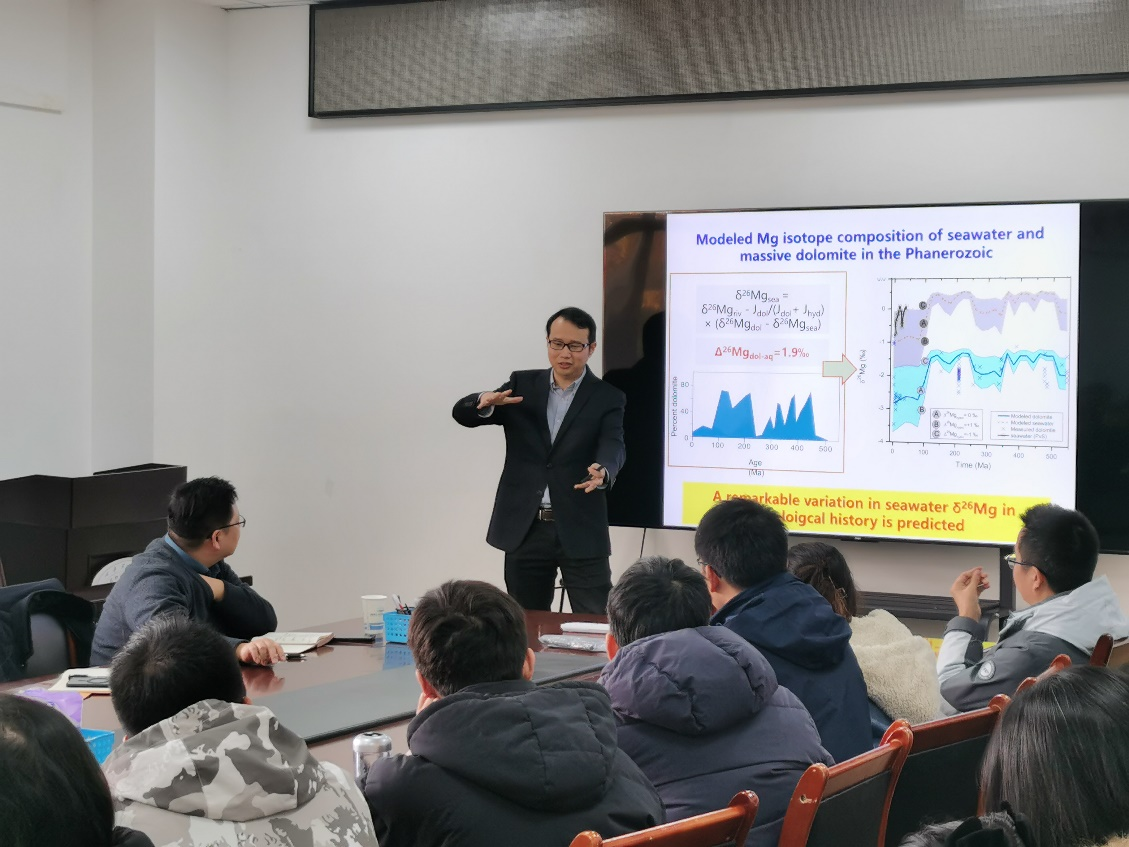
The presentation included the work accumulated by Professor Li over the past decade on the topic of magnesian isotope research of dolostone. At the beginning of the talk, Professor Li introduced the hypothesis regarding dolomitization and the long-term chemical evolution of seawater, highlighting the potential of magnesian isotope research in verifying this hypothesis. Therefore, in order to establish and improve the system of magnesian isotope research in dolostone, Professor Li specifically introduced the process of mineral synthesis and recrystallization experiments to accurately calibrate the magnesian isotope fractionation between dolomite and aqueous solutions. He also evaluated the influence of geological processes such as burial diagenesis, hydrothermal alteration, early diagenesis, and basin restriction on the behavior of magnesian isotopes in dolostone. Furthermore, he proposed the rapid change in magnesian isotopes in dolostone as evidence of the Guadalupian Capitanian event and its relationship with the Permian-Triassic mass extinction event. Finally, he pointed out the potential of thick marine dolostone in reconstructing the magnesium isotope composition of ancient seawater and tracing major geological processes such as long-term chemical evolution of seawater and global carbon cycling.
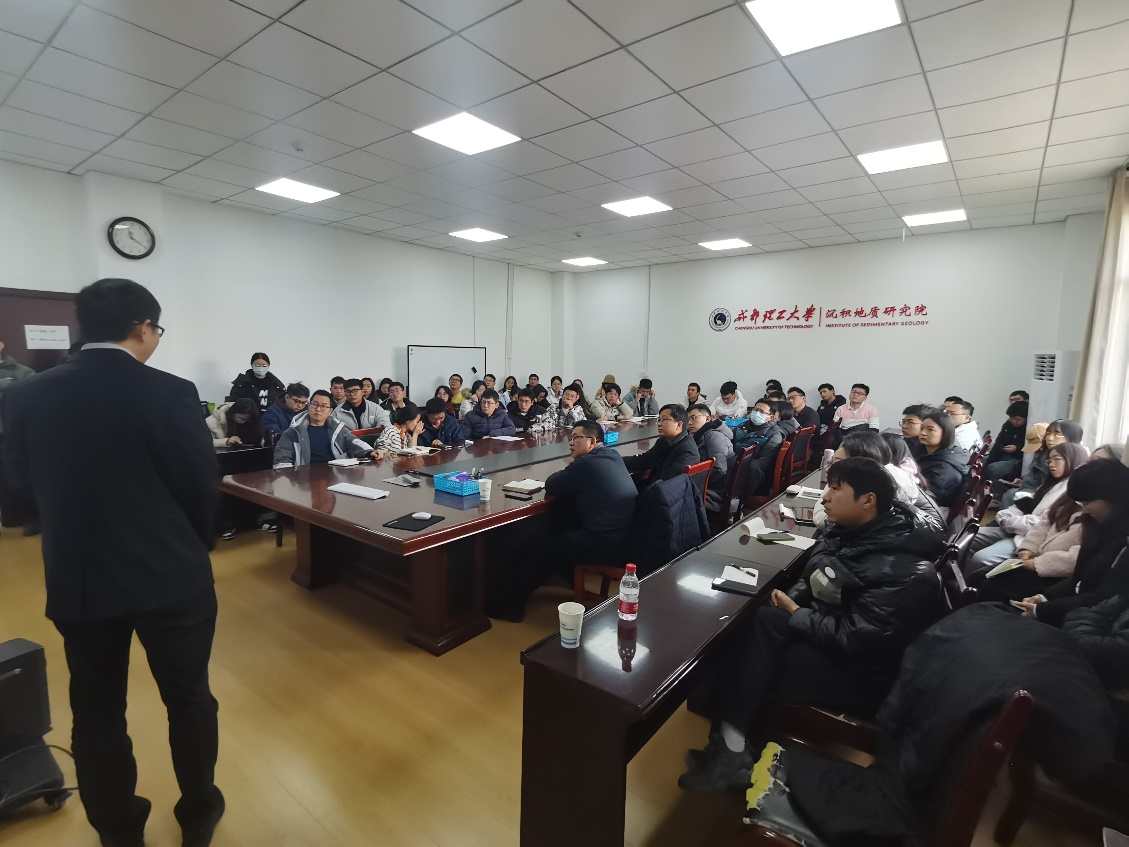
During the subsequent discussion session, the teachers and students at the venue engaged in lively discussions on various aspects, including dolostone issues, the response of magnesian isotopes in dolostone to oceanic restriction events, the impact of weathering on the composition of seawater magnesian isotopes, the composition of magnesian isotopes in modern sabkha environments, and the fractionation coefficient of balanced magnesian isotopes between dolostone and solution under the influence of microbial participation.
Professor Weiqiang Li’s brief biography:
He received his PhD from Macquarie University in Australia in 2009 and conducted postdoctoral research at the University of Wisconsin-Madison from 2009 to 2014, serving as an assistant research scientist. He joined the School of Earth Sciences and Engineering at Nanjing University in 2014 as a professor and doctoral supervisor, and in 2016, he received funding from the National Natural Science Foundation for Young Scientists. Over the past decade, Professor Li has been devoted to non-traditional metal stable isotope geochemistry research (including K, Sn, Mg, Fe, Cu, Zn isotopes). He has published over 40 papers as the first/ corresponding author in international journals such as PNAS, EPSL, GCA, and Analytical Chemistry, including 25 papers in Nature Index journals. He currently serves as an editor for EPSL and as the associate editor of GCA and Geochemistry journals.