A research team led by Professor Chao Li from the Chengdu University of Technology has achieved a significant breakthrough in the quantitative analysis of dissolved organic matter (DOM) in ancient oceans. The team has developed a novel proxy termed Carbonate-Associated Fluorescent Dissolved Organic Matter (CAFDOM), which offers a unique and powerful technical pathway for directly quantifying and characterizing DOM in paleo-marine environments. This pioneering work, published in Geochimica et Cosmochimica Acta, effectively addresses the long-standing "bottleneck" in paleo-marine DOM research and opens new avenues for understanding global carbon cycling and Earth-life co-evolution.
1. Research Background: The Bottleneck in Ancient Ocean DOM Research
Dissolved organic matter constitutes the largest reservoir of reduced carbon (as Dissolved Organic Carbon, DOC) in the modern ocean, comparable in size to the atmospheric CO2 pool, and plays a pivotal role in global carbon cycles and climate dynamics. Previous studies suggest that the DOM reservoir in ancient oceans during certain geological periods (e.g., the Neoproterozoic) could have been 100 to 1000 times larger than today, potentially exerting a more crucial influence on Earth's environmental and biological co-evolution. However, the lack of direct, reliable quantitative proxies has left the size, composition, and evolutionary history of ancient DOM pools largely unresolved. Existing research has relied on indirect evidence like carbonate carbon-oxygen isotopes, redox proxies, elemental enrichment patterns, and carbon cycle models, often leading to conclusions with significant ambiguity and uncertainty. A recent method using coprecipitated organic matter in iron ooids, published in Nature (Galili et al., 2025), enables direct analysis but is limited to shallow, oxic waters and is sparsely distributed in Precambrian strata, restricting its spatiotemporal applicability. Therefore, establishing a new proxy capable of direct, systematic, and high-resolution quantitative analysis of DOM across different water depths in ancient oceans is imperative for a breakthrough in this field.
2. Technical Breakthrough: Establishment of the CAFDOM Analytical Method
To tackle this core challenge, Professor Li's team innovatively applied the modern environmental analytical technique of "Three-Dimensional Excitation-Emission Matrix Fluorescence Spectroscopy combined with Parallel Factor Analysis (3D EEM-PARAFAC)" to ancient carbonate rocks. After years of dedicated research, the team has developed a standardized protocol for DOM extraction and detection from geological carbonate samples. The core innovation of the CAFDOM method lies in a three-in-one technical breakthrough achieving "precise separation, targeted extraction, and accurate quantification."
First, a high-temperature ashing pre-treatment at 530℃ effectively removes interfering organic matter hosted in non-carbonate phases (e.g., clays) and intercrystalline organic matter. Subsequently, weak acid dissolution selectively releases organic matter trapped within the carbonate mineral lattice. Finally, the extracted fluorescent DOM is subjected to reliable component identification and concentration quantification using 3D EEM-PARAFAC. This protocol has been validated using simulated carbonate samples, demonstrating excellent reproducibility (relative standard deviations for all components < 11%) and high extraction efficiency (average exceeding 80%).
3. Key Discovery: CAFDOM's Response to Seawater DOM and Reconstruction Methodology
Steady-state carbonate precipitation experiments using fulvic acid as a model for natural DOM revealed that CAFDOM content responds positively to solution DOM concentration inthree distinct modes (Fig. 1):
Mode 1 (0-0.4 g/L): Exponential increase from zero.
Mode 2 (0.4-1.4 g/L): A second exponential increase from zero.
Mode 3 (>1.4 g/L): A weak linear increase from a specific threshold.
These modes are likely linked to critical shifts in DOM intermolecular forces and aggregation states (from free molecules to aggregates to colloids) during incorporation into the carbonate lattice. The study also found that smaller, tryptophan-like fluorescent molecules are preferentially incorporated into CAFDOM compared to larger, humic-like molecules.
Crucially, the research proposes a composite approach to reconstruct ancient ocean DOM concentrations. By combining the absolute abundances and pairwise ratios (e.g., C3/C1, C2/C1) of the identified CAFDOM components (see Fig. 1d), and further constraining the likely DOM concentration range with additional sample information (e.g., paleo-geographic setting, redox conditions), the ambiguity between Modes 1 and 2 can be resolved, enabling quantitative reconstructions.
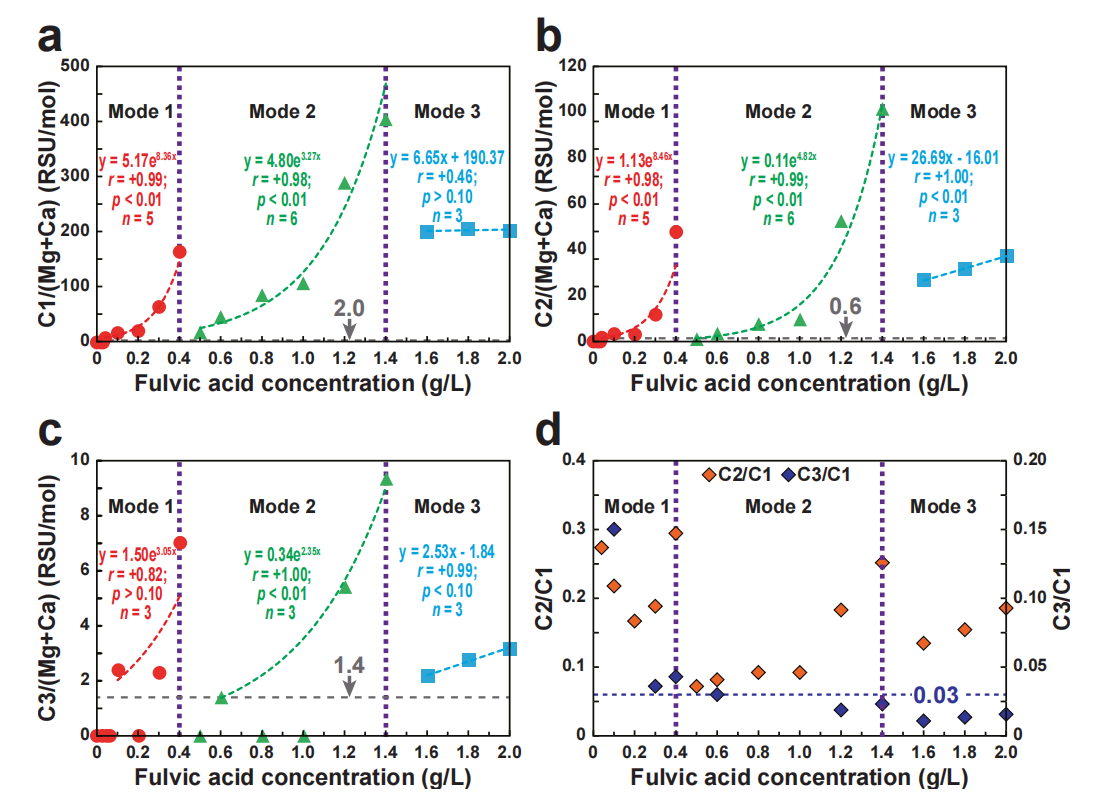
Figure 1. Response of CAFDOM to solution DOM concentration. (a-c) The three distinct response modes of CAFDOM components (C1, C2, C3) to increasing fulvic acid concentration. (d) Ratios of CAFDOM components (C2/C1, C3/C1) change systematically across the three modes, aiding in mode discrimination for quantitative reconstruction. (Based on data from Wang et al., 2026, GCA).
4. Geological Application and Validation: From Modern Drill Cores to the Ediacaran Deep-Time Ocean
The team applied the CAFDOM method to carbonates with known diagenetic histories from IODP (International Ocean Discovery Program) drill cores and well-preserved Ediacaran (~635-551 million years ago) carbonate rocks from the Doushantuo Formation in South China.
Diagenetic Impact Assessment: Analysis of IODP samples revealed that primary CAFDOM signals can be altered by aragonite-to-calcite recrystallization, authigenic carbonate precipitation, and replacement dolomitization. This provides critical criteria for sample selection and diagenetic signal correction in practical applications.
Geological Application Verification: Valid CAFDOM signals were successfully detected in pristine Ediacaran carbonate samples. The contents of CAFDOM components showed synchronicity with the carbonate carbon isotope (δ13Ccarb) record (Fig. 2), providing direct geochemical evidence for dynamic changes in the deep-time ocean DOM reservoir. This preliminarily supports hypotheses like the "Large Neoproterozoic Oceanic DOC Reservoir."
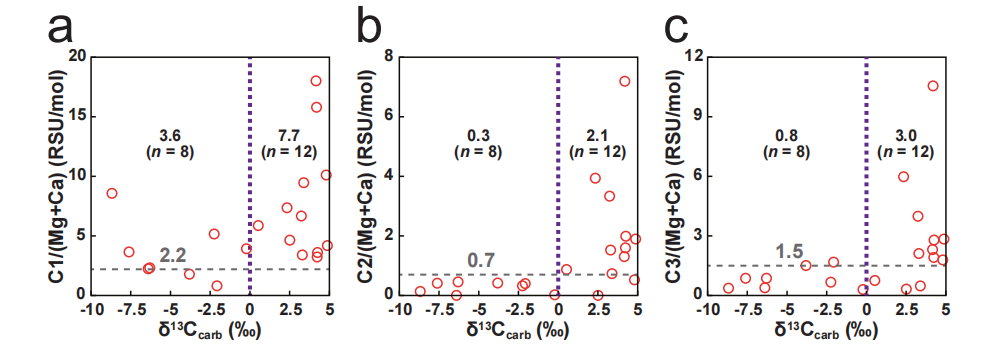
Figure 2. CAFDOM record from the Ediacaran Doushantuo Formation. The contents of CAFDOM components (C1, C2, C3) co-vary with the carbonate carbon isotope (δ¹³Ccarb) record, providing direct evidence for fluctuations in the ancient ocean's dissolved organic matter reservoir. (Based on data from Wang et al., 2026, GCA).
5. Research Significance: Opening a New Dimension in Paleo-Ocean DOM Research
The newly developed CAFDOM proxy enables the direct quantitative reconstruction of the properties and concentration of DOM in ancient oceans. Compared to the iron ooid proxy with significant spatiotemporal limitations, CAFDOM leverages the ubiquitous and environmentally diverse carbonate rock record, allowing for high-resolution, direct quantitative reconstructions of DOM evolution across shelf to basin environments throughout geological history.
This achievement fills a critical technical gap in paleo-ocean DOM quantitative research. It provides a powerful new tool to decipher the size, composition, and evolution of ancient ocean DOM pools, which will significantly advance our understanding of Earth's carbon cycle, redox evolution, and the co-evolution of Earth's environment and life.
Publication Information:
Wang, W., Li, C., Dodd, M. S., Xu, H., Cheng, M., Zhang, Z., Yang, C., Hu, J., Wang, H., Chen, X., Immenhauser, A., 2026. Carbonate-associated fluorescent dissolved organic matter (CAFDOM): Establishing a new proxy for dissolved organic matter in ancient oceans. Geochimica et Cosmochimica Acta. doi.org/10.1016/j.gca.2026.03.006.
Postdoctoral researcher Wei Wang is the first author, and Professor Chao Li is the corresponding author. The research was supported by the National Natural Science Foundation of China, the National Key Research and Development Program of China, the "111" Project, and the Natural Science Foundation of Sichuan Province.