A research team led by Professor Chao Li from Chengdu University of Technology, together with global collaborators, has published a landmark study in Nature Communications. Entitled “Recurring marine phosphorus spikes during major Palaeozoic mass extinctions and climate change”, this work presents the first direct, systematic geochemical evidence that transient marine phosphorus pulses are closely linked to two of the most severe mass extinction events in the Palaeozoic Era.
Research Background: The Unverified "Phosphorus Driver" Hypothesis
The Late Ordovician Mass Extinction (LOME, ~445 million years ago) and the Late Devonian Mass Extinction (LDME, ~372 million years ago) are among the "Big Five" extinction events in Earth's history. A long-standing hypothesis suggests that increased nutrient input, particularly phosphorus, into the oceans could have triggered a chain reaction: eutrophication, expanded ocean anoxia, enhanced organic carbon burial, atmospheric CO2 drawdown, and global cooling. However, a critical piece of evidence was missing: a direct, reliable proxy to quantitatively reconstruct changes in ancient seawater phosphate concentrations, leaving the "phosphorus driver" hypothesis unverified.
Technical Breakthrough: The Novel CAP Proxy
To tackle this challenge, Professor Li's team applied their self-developed Carbonate-Associated Phosphate (CAP) geochemical proxy to ancient carbonate rocks. The CAP method innovatively extracts and quantifies the phosphate captured within the carbonate mineral lattice during its formation, providing a novel tool to reconstruct paleo-seawater phosphate levels.
Key Discovery: Globally Synchronous Phosphorus Pulses During Extinctions
The team analyzed samples from seven globally distributed sections spanning the LOME and LDME intervals. The CAP data revealed a striking pattern: short-lived, globally coherent spikes in marine phosphorus levels coincided precisely with the major pulses of both mass extinction events (Fig. 1).
During the LOME, a significant CAP pulse aligned with the second extinction phase (LOME 2), correlating with evidence for widespread anoxia.
During the LDME, two CAP pulses were identified, corresponding to the Lower and Upper Kellwasser (LKW, UKW) extinction events.
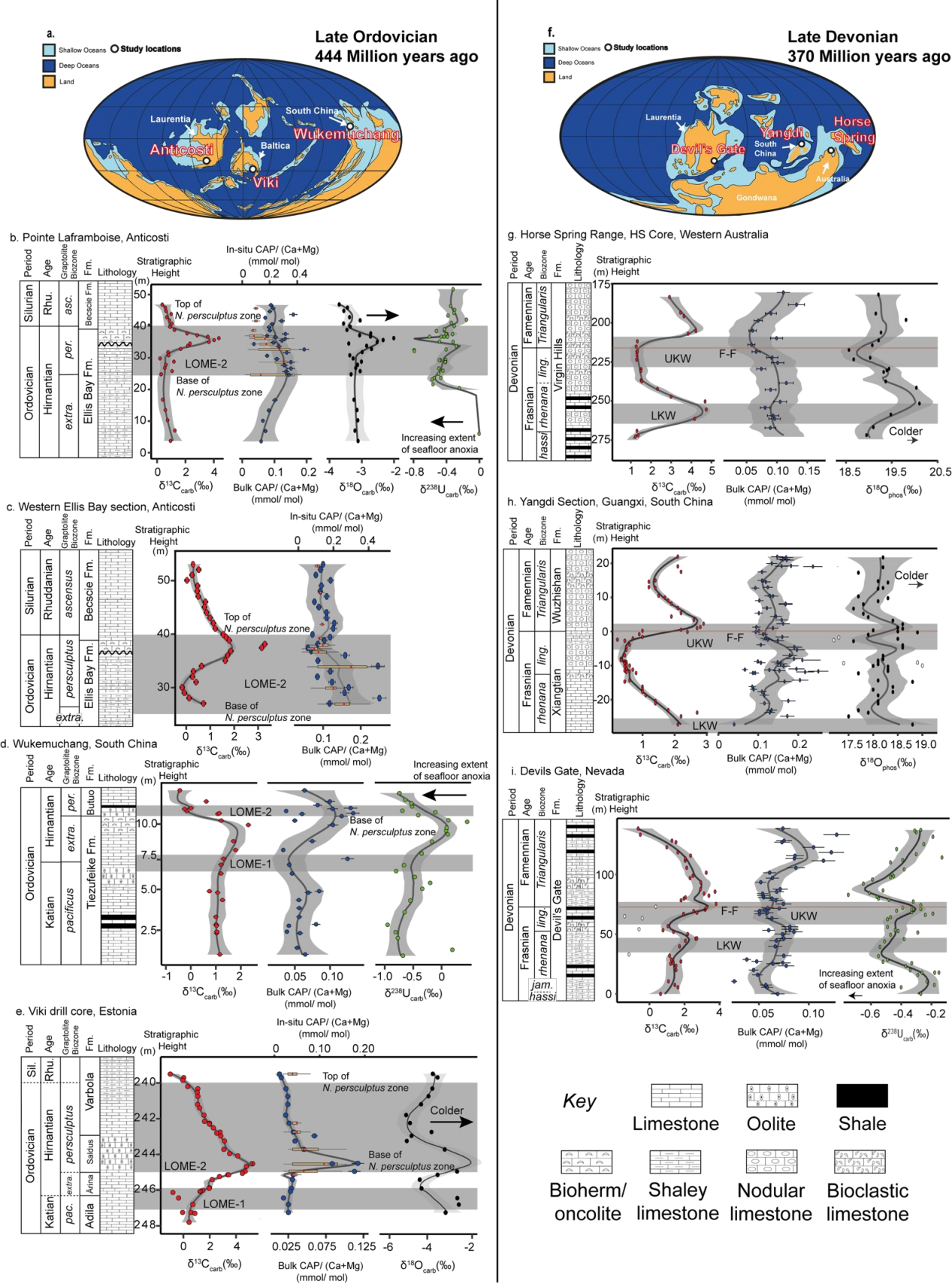
Figure 1. Biogeochemical data from study sections during the Late Ordovician and Late Devonian mass extinction events. The panels show correlations between the Carbonate-Associated Phosphate (CAP) record (this study) and independent geochemical proxies (carbon isotopes, uranium isotopes, oxygen isotopes) across globally distributed sections. The synchronized CAP spikes with extinction horizons (LOME 1/2, LKW/UKW) are clearly visible. (Based on Dodd et al., 2026, Nat. Commun.).
Mechanism Validation: Biogeochemical Modeling Confirms the Chain Reaction
The study employed the SCION biogeochemical model to simulate the environmental impact of the observed P pulses. The model results demonstrated that a transient increase in marine phosphorus availability could drive a cascading series of global changes (Fig. 2):
1. Surge in marine primary productivity (matching positive carbonate carbon isotope excursions).
2. Expansion of ocean anoxia (matching negative uranium isotope shifts).
3. Increased organic carbon burial and atmospheric O2 rise.
4. Drawdown of atmospheric CO2 leading to global cooling (consistent with oxygen isotope paleothermometry).
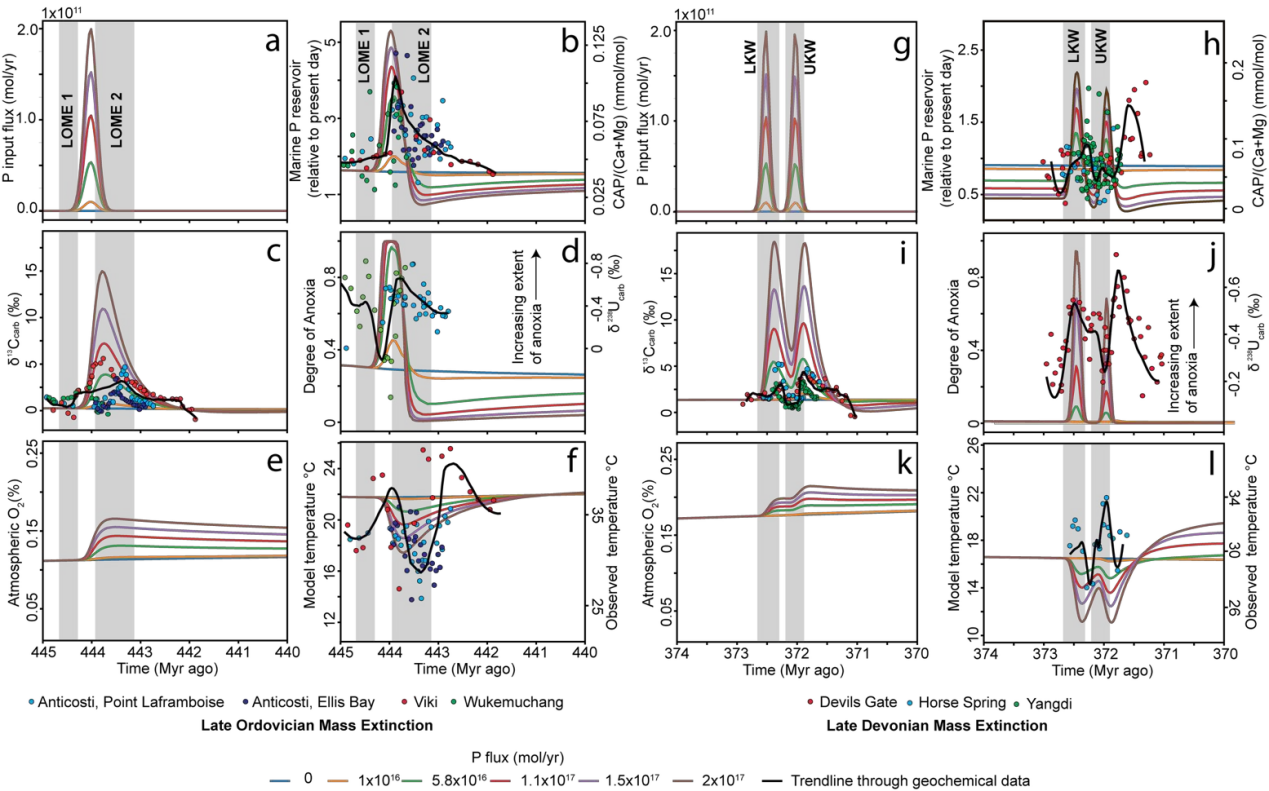
Figure 2. Biogeochemical model results with overlain proxy data for the Late Ordovician (a-f) and Late Devonian (g-l) events. The model successfully simulates the cascade from prescribed phosphorus input (a, g) to increased marine P concentration (b, h), positive carbon isotope excursion (c, i), expanded anoxia (d, j), rising atmospheric O₂ (e, k), and global cooling (f, l), matching the geological proxy records. (Based on Dodd et al., 2026, Nat. Commun.).
Research Significance: Resolving a Long-Standing Debate and Revealing Complex Mechanisms
This research provides the first quantitative, geochemical validation of the "phosphorus driver" hypothesis for these early Palaeozoic extinctions. The findings confirm that brief, recurring pulses of phosphorus into the ocean acted as a key trigger, amplifying environmental crises through Earth system feedbacks.
Furthermore, the study offers a more nuanced understanding: Not all extinction phases were equally tied to high phosphorus. The first pulse of the LOME (LOME 1) occurred under relatively low CAP conditions, suggesting glaciation and sea-level fall as initial drivers.
Phosphorus-driven anoxia may have played a greater role in suppressing ecosystem recovery after the initial extinction, as suggested by the post-extinction CAP peak during the LDME which did not cause a new extinction but coincided with a prolonged "reef gap."
Professor Chao Li, co-first and corresponding author, stated: "This study provides the first direct, quantitative geochemical evidence for the classic phosphorus-driven extinction hypothesis, completing a critical link in the chain of evidence. The CAP data allow us to quantitatively reconstruct the real changes in ocean phosphorus concentrations during mass extinctions and precisely correlate them with biological responses and environmental changes, greatly deepening our understanding of the mechanisms of environmental and life co-evolution."
Dr. Matthew S. Dodd from the University of Western Australia, co-first and corresponding author, added: "Our research shows that relatively short-term phosphorus input disturbances can be amplified by Earth's biogeochemical feedbacks into global environmental upheaval. This enhances our comprehension of how the Earth system operates under extreme environmental stress."
Publication Information: Dodd, M.S., Li, C., Zhang, Z., et al. Recurring marine phosphorus spikes during major palaeozoic mass extinctions and climate change. Nature Communications (2026). https://doi.org/10.1038/s41467-026-70701-y.
Dr. Matthew S. Dodd and Professor Chao Li are the co-first and corresponding authors. The research involved 15 scholars from China, Australia, Canada, the USA, Estonia, and the UK. The work was supported by the National Natural Science Foundation of China and the National Key Research and Development Program of China, among other funding bodies.