The team, led by Professor Chao Li, published an important research paper titled “Uncovering the Ediacaran phosphorus cycle” in Nature, online on May 31, 2023. This is the first Nature research paper with Chengdu University of Technology as the first author institution since its establishment. The research involved experts and scholars from China University of Geosciences (Wuhan), Michigan State University (East Lansing), California State University (Fresno), the University of Melbourne, the University of Leeds, and the University of California (Riverside). Using the Carbonate-Associated Phosphate (CAP) technique, newly developed by Professor Chao Li’s team to directly track fluctuations in ancient oceanic phosphorus content, the study reconstructed the evolution of dissolved phosphorus content during the crucial Ediacaran period (635-539 million years ago), revealing a decoupling relationship between phosphorus content and oceanic oxygenation different from the modern ocean. The study proposed the hypothesis that external factors drove the transition from anoxic to oxidative conditions in the Ediacaran ocean and potentially throughout the early Earth’s oceans. This discovery sheds light on the fundamental reasons for the prolonged anoxic state of the pre-Cambrian ocean and the underlying mechanisms that led to the eventual oxygenation of the early Earth’s anoxic oceans, significantly deepening our understanding of the evolution of Earth’s habitability and the development of complex life forms. This finding also has important implications for the formation and exploration of related mineral resources and oil and gas resources in the early Earth’s oceanic environments.
Paper Information: Matthew Dodd, Wei Shi, Chao Li*, Zihu Zhang, Meng Cheng , Haodong Gu , Dalton Hardisty, Sean Loyd, Malcolm Wallace, Ashleigh Hood, Kelsey Lamothe. Benjamin Mills, Simon Poulton, Timothy Lyons. (2023) Uncovering the Ediacaran phosphorus cycle. Nature. ISSN 0028-0836. DOI: s41586-023-06077-6, Link: https://www.nature.com/articles/s41586-023-06077-6
As a critical component of life, phosphorus (P) is the primary nutrient controlling modern and geological productivity in the ocean, while oxygen (O2) is an essential oxidant for complex eukaryotic metabolism. Understanding the relationship between these two elements is crucial for the study of Earth's habitability. In the modern ocean, P and O2 (or oxygenation) exhibit a negative feedback relationship on a geological timescale of millions of years: when oceanic O2increases, the ocean removes P from seawater and sequesters it into sediments through processes like increased iron oxide adsorption, leading to a decrease in oceanic productivity and oxygen production through photosynthesis, thereby preventing further oceanic oxygenation. Conversely, when oceanic O2 levels decrease (such as during oceanic anoxic events), P is reactivated from sediments and released back into the ocean, increasing oceanic productivity and oxygen levels, thereby preventing the expansion of oceanic anoxia. This negative feedback mechanism largely maintains the modern ocean, and even the Phanerozoic ocean (<539 million years ago), as an oxygenated environment, enabling the proliferation of complex eukaryotic life on Earth. Many studies have shown that the pre-Cambrian (>539 million years ago) ocean had a stratified structure, with oxidation only present in the surface layer, while anoxia dominated the majority of the ocean. So, does the Phanerozoic oxygenated ocean P-O2 negative feedback process also exist in the pre-Cambrian ocean? Scientists have not been able to provide a definitive answer to this question, mainly due to the lack of quantitative indicators capable of directly and effectively tracking variations in dissolved P content in ancient oceans, making it difficult to quantitatively assess fluctuations in dissolved P content in ancient oceans. In this regard, Professor Chao Li’s team has made continuous efforts and successfully developed a new indicator, Carbonate-Associated Phosphate (CAP), in 2021, which can directly track fluctuations in ancient oceanic P content, providing a potential answer to the above significant scientific questions.
The Ediacaran Period, as a transition period between the Precambrian and the Phanerozoic, witnessed early animal diversification, atmospheric-oceanic oxidation, and one of the most significant carbon isotope (δ13Ccarb) negative excursions in Earth's history, known as the Shuram Excursion (SE) event. There is evidence suggesting that the oceanic phosphorus cycle also underwent a major transition during the Ediacaran, shifting from a small, anoxic, slow cycling P reservoir in the Precambrian to a larger, oxic, fast-cycling P reservoir in the modern ocean. Investigating the P cycling during this period could provide answers to the major scientific question of the early Earth’s oceanic P-O2 cycle interaction.
SE event is one of the most important ancient ocean oxidation events in the Ediacaran. The dramatic negative carbon isotope excursion (δ13Ccarb) during the SE event is often explained by the oxidation of dissolved organic matter (DOM) in the ancient ocean, which released isotopically light inorganic carbon that contributed to the formation of sedimentary carbonates. Additionally, SE event strata are typically composed of carbonate rocks, which is favorable for the application of carbonate-associated phosphate (CAP) techniques. Therefore, SE event strata in the Ediacaran undoubtedly become the preferred target.
Under the coordination of Professor Chao Li, team members Matthew Dodd, Zihu Zhang, Meng Cheng, and Haodong Gu collected samples from six different regions on four ancient continents, including China’s South China and Tarim regions, Australia, the United States, and Mexico, with the assistance of researchers from Michigan State University-East Lansing, California State University-Fullerton, University of California-Riverside, the University of Melbourne, and related domestic institutions. They analyzed the corresponding CAP and δ13Ccarb data. The results show that during the SE event, the CAP composition in various regions exhibited pulse-like increases in both the initial negative δ13Ccarb phase and the later recovery phase, displaying an “M” shaped evolutionary trend (Figure1). This phenomenon contrasts sharply with the monotonous increase followed by a monotonous decrease in marine oxidation indicated by the δ238U data in the same stratum (Figure1). One surprising finding is that although the δ238U data shows the most oxidation in the ocean, the dissolved P content in the ancient ocean recorded by the CAP is indeed at its lowest value, which is not significantly different from the CAP value when the δ238U data indicates the weakest marine oxidation before and after the SE event. In addition, at the beginning of the SE event, the δ238U data shows a gradual oceanic oxidation, while the CAP record starts to increase and shows the first peak of the “M” pattern. These observations suggest that changes in the P content in the ancient ocean were largely decoupled from the oceanic oxidation, which is in stark contrast to the expected coupled relationship between P and O2 cycling in the Phanerozoic ocean.
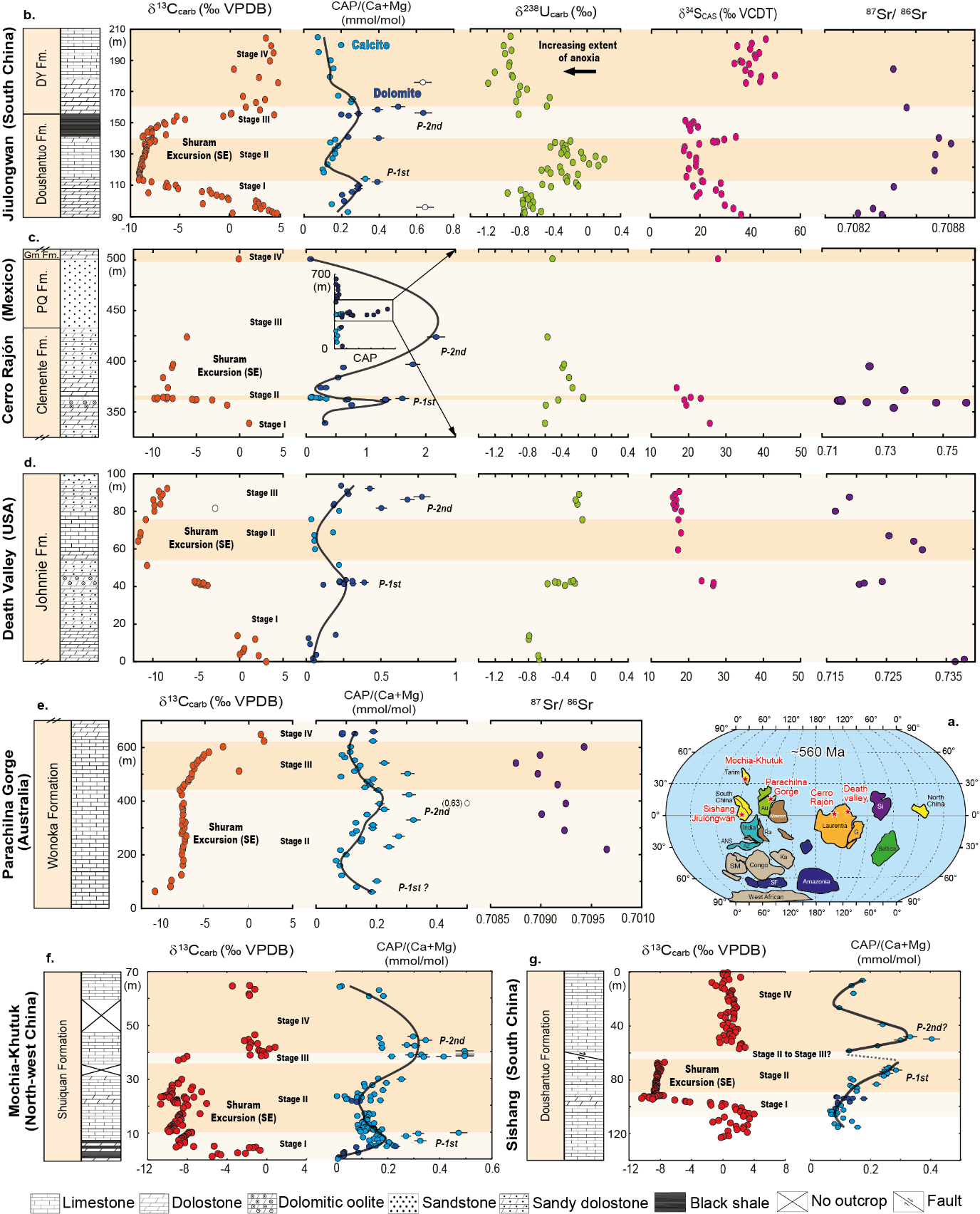
Figure 1. CAP and related geochemical records (b-g) from six Ediacaran profiles (a) across four ancient continents worldwide. These six profiles capture the largest inorganic carbon isotope negative excursion in geological history - the Shuram Excursion (SE) event.
To explain the unique “M” shaped evolutionary trend of CAP during the SE event and its relationship with the ancient oceanic oxidation-reduction evolution recorded by δ238U, the research team also tested or collected and compared the corresponding carbonate-bound sulfur isotope (δ34SCAS) and strontium isotopes (87Sr/86Sr) in the sedimentary strata. Together with Dr. Wei Shi from the University of Leeds, Dr. Benjamin Mills performed quantitative simulations using the improved Carbon-Oxygen-Phosphorus-Sulfur Evolution (COPSE) model to interpret the multi-element geochemical records of CAP-δ238U-δ13Ccarb-δ34SCAS-87Sr/86Sr during the SE period. The research found that the “M” shaped evolutionary trend of CAP can be nearly perfectly explained by the C-O-P-S cycle driven by the oxidation of sulfate in the ancient oceanic DOM reservoir (Figures 2-3). Specifically, Stage 1: In the early stages of the SE event, the input of highland-derived sulfates into the ocean due to highland weathering led to the oxidation of ancient ocean DOM, releasing P bound in the DOM and causing the first pulse-like increase in CAP. In addition, the CO2released from the oxidation of DOM increases pCO2, which further accelerates the weathering flux of continental silicates and the flux of weathering P transported to the ocean, together leading to the rapid increase in CAP for the first time. Stage 2: The increase in oceanic P in Stage 1 enhances marine productivity and organic carbon burial, promoting the release of oxygen and increasing the degree of marine oxidation. The oxidation of ferromanganese oxides in the seawater gradually predominates over the oxidation release of P in DOM, resulting in a decrease in P concentration in seawater and a decrease in CAP. Stage 3: The decline in oceanic phosphorus content in Stage 2 will lead to a decrease in oceanic productivity and oxygen production, resulting in an increase in the degree of oceanic hypoxia. Ultimately, this will lead to the adsorption of iron-manganese oxides in sediments being lower than the release of DOM-P, leading to the second pulse of CAP. Stage 4: As DOM is exhausted and input of terrestrial weathered sulfate declines, SE events tend to end, and the release of DOM-P gradually ends, resulting in a gradual decline in CAP.
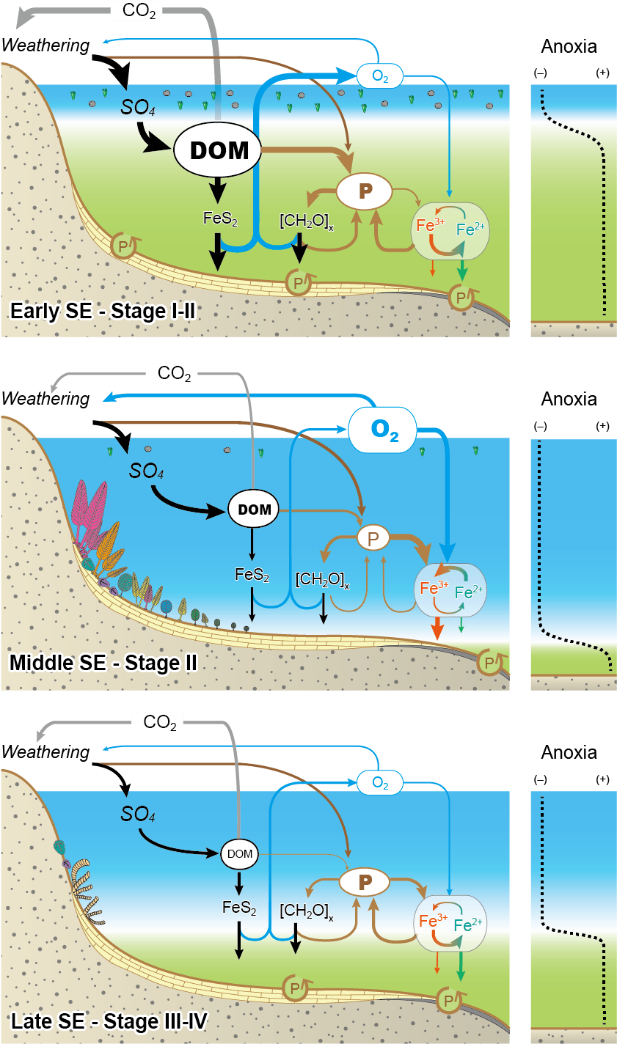
Figure 2. Conceptual model illustrating the coupled evolution of ancient ocean phosphorus cycling and the oxidation of dissolved organic matter (DOM) during the Ediacaran Shuram Excursion (SE) event. This model qualitatively explains the synchronous fluctuations observed in the CAP and related ancient ocean carbon cycle, redox conditions, and terrestrial weathering records during the SE period.
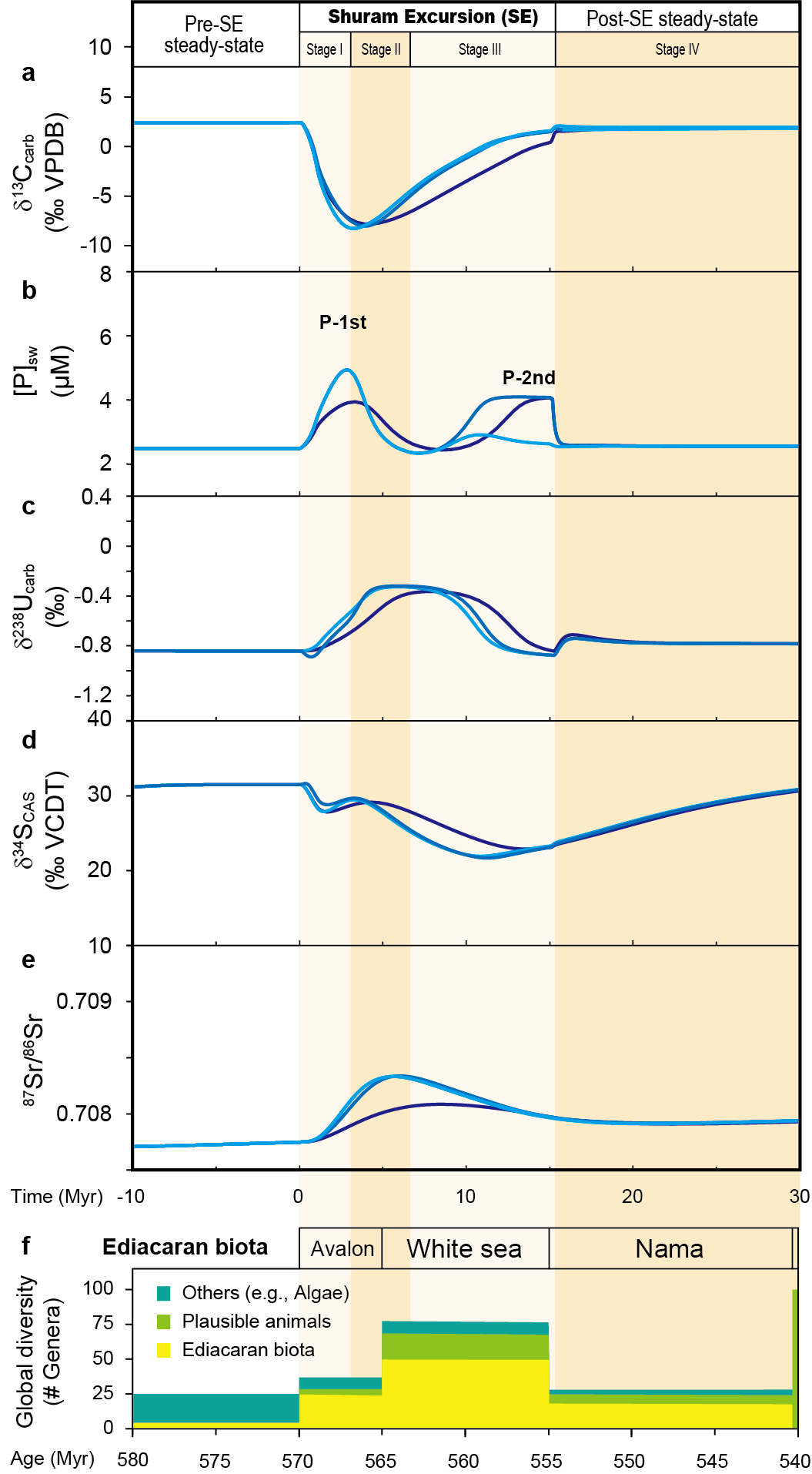
Figure 3. Quantitative interpretation of the observed synchronous fluctuations in CAP (b) and C- (a), U- (c), S- (d), and Sr (e) isotope records during the Ediacaran Shuram Excursion (SE) event based on the qualitative conceptual model in Figure 2. The fossil record of the Ediacaran period (f) provides evidence of the influence of the Ediacaran C-O-S-P cycle on the early evolution of complex eukaryotic life.
Professor Chao Li believes that the decoupling of the Ediacaran oceanic P-O2 cycle was likely related to the small P pool in ancient oceans. This may have been a result of the continuous removal of oceanic P by organic phosphorus or blue iron ore in the widespread anoxic iron-enriched environments at that time. “Previous research has shown that the Ediacaran ocean shares similar chemical characteristics with pre-Cambrian oceans. Therefore, the decoupling or weak coupling between the internal P-O2 cycle observed in this study may have existed throughout the pre-Cambrian era. If so, this decoupling or weak coupling will lock the atmosphere-ocean system of the pre-Cambrian in a long-term anoxic state. This explains why such a long pre-Cambrian era could remain stable in a predominantly anoxic state,” said Professor Chao Li. “The qualitative explanation and quantitative simulation results of this study indicate that the aforementioned CAP-δ238U-δ13Ccarb-δ34SCAS-87Sr/86Sr multivariate geochemical records can only be recapitulated synchronously when terrestrial weathered sulfate is injected into the ocean and triggers the oxidation of oceanic DOM, according to the aforementioned process. This suggests that to break the decoupling of the pre-Cambrian oceanic internal P-O2 cycle and achieve oceanic oxidation, external factors may be needed to drive the ocean, such as the rapid input of terrestrial weathered sulfate in this study that triggered the oxidation of the ocean during the SE period. This explains why the oxygenation of the earth’s surface and the rise of complex life are so slow. All of this needs to wait until the widespread iron-enriched conditions in the ocean disappear, the oceanic sulfate content is greatly increased, and the modern coupling of the oceanic P-O2cycle is established!”
This achievement is a concentrated manifestation of Professor Chao Li's research team's long-term work on environmental evolution during the late Neoproterozoic-early Paleozoic period over the past 20 years. Professor Chao Li's research team focuses on driving scientific innovation with technological innovation and has gradually formed a theoretical system of atmospheric-oceanic system evolution characterized by the coupled carbon-oxygen-sulfur-phosphorus cycle in the pre-Cambrian period, which has been published in Science, PNAS, Geology, EPSL, GCA, Science Bulletin, Science China: Earth Science and other domestic and foreign important academic journals. Currently, Chengdu University of Technology has established the International Center for Sedimentary Geochemistry and Biogeochemistry Research, led by Professor Chao Li, based on the Institute of Sedimentary Geology and the State Key Laboratory of Oil and Gas Reservoir Geology and Exploitation, aiming to build an internationally first-class research and technology platform and looking forward to working with domestic and foreign counterparts to jointly explore the peak of earth sciences.
This achievement was supported by the National Natural Science Foundation of China (41825019, 42130208, 41821001), the National Key R&D Program of China (2022YFF0800100), the China Postdoctoral International Exchange Program, the China Postdoctoral Science Foundation, the Forrest Research Foundation, the Earth Science Department of the University of Western Australia, and the NASA Institute for Astrobiology (Cooperative Agreement NNA15BB03A).
Author contributions: Professor Chao Li (Chengdu University of Technology) led this research. Professor Chao Li and Dr. Matt Dodd (a visiting scholar introduced by Professor Chao Li at Chengdu University of Technology, formerly a postdoctoral researcher under Professor Chao Li) designed this research. Dr. Matt Dodd, Dr. Zhang Zihu (Chengdu University of Technology), Dr. Meng Cheng (Chengdu University of Technology), and Dr. Haodong Gu (China University of Geosciences-Wuhan) conducted experimental analysis. Dr. Wei Shi (Chengdu University of Technology) and Associate Professor Ben Mills (University of Leeds, UK) conducted model analyses. Professor Chao Li, Professor Timothy Lyons (University of California, Riverside), Dr. Dalton Hardisty (Michigan State University, East Lansing), Dr. Sean Loyd (California State University, Fullerton), Dr. Malcolm Wallace (The University of Melbourne, Australia), Dr. Ashleigh Hood (The University of Melbourne, Australia), Dr. Kelsey Lamothe (University of Melbourne, Australia), Researcher Meng Cheng, and PhD student Haodong Gu provided samples and conducted field work. Professor Simon Poulton (University of Leeds, UK) provided assistance with analysis. Dr. Matt Dodd, Professor Chao Li, and Dr. Wei Shi drafted the manuscript and received discussion and assistance from all co-authors.
This report was written by Wei Shi , Meng Cheng, Chunxia Yang, Chao Li