On October 26, 2023, the latest collaborative research entitled “Spatial Pattern of Marine Oxygenation Set by Tectonic and Ecological Drivers over the Phanerozoic" by Dr. Xiangli Wang from the Institute of Geology and Geophysics, Chinese Academy of Sciences, and Professor Chao Li from the International Center for Sedimentary Geochemistry and Biogeochemistry Research at Chengdu University of Technology, was published online in Nature Geoscience. Dr. Xiangli Wang is the first author of the article, and Professor Chao Li and Dr. Xiangli Wang are the corresponding authors. Experts and scholars from the University of Cincinnati in the United States and the Nanjing Institute of Geology and Palaeontology, Chinese Academy of Sciences, also participated in this research.
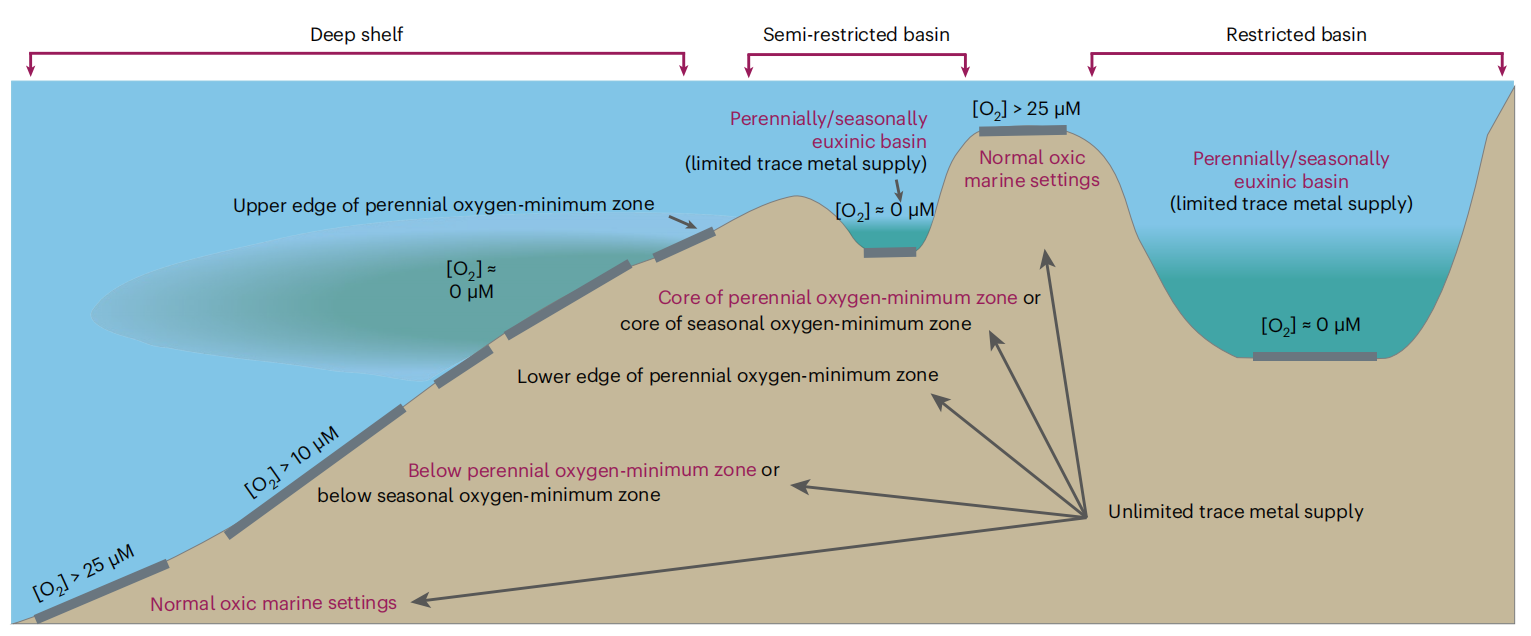
Illustrated Diagram of Shale Depositional Environment
The variations in dissolved oxygen content in the ocean profoundly affect the elemental biogeochemical cycles and habitability evolution of the Earth. However, the trends of ocean redox state evolution and their driving mechanisms since the Phanerozoic (<~538 Ma) are still unclear. This study used big data analysis and machine learning methods to reconstruct the nearly continuous spatiotemporal evolution record of marine redox conditions since the Phanerozoic, based on changes in trace metal element content in shales. The study found that from the Cambrian to the Devonian, before the colonization of plants on land, the deep shelf regions were generally still in an anoxic state. After the Devonian, the range of oceanic anoxia contracted, and a persistent and stable zone of minimum marine oxygen gradually appeared, forming the modern pattern of oceanic oxygenation. This long-term evolution on scales of tens to hundreds of millions of years is positively correlated with the rate of crustal accretion (i.e., tectonic activity) and sea-level changes dominated by tectonic activity, indicating that tectonic activity intensity may be one of the major controlling factors influencing the marine redox state. On the scales of millions of years in the Phanerozoic, upper seawater and deep shelf-(semi)restricted basin water exhibited reverse changes in redox conditions. This feature highly coincides with key life evolutions (such as the expansion of Paleozoic land vegetation and the Mesozoic planktonic revolution) and tectonic events (such as the assembly and breakup of the Pangea supercontinent), indicating significant influences of tectonic and ecosystem evolution on the evolution of the marine redox state during the Phanerozoic.
This research was supported by the National Natural Science Foundation of China (41888101, 42293293, 41921002, 41821001, 41825019, 42130208), the National Key Research and Development Program (2022YFF0800100, 2020YFA0607700), and the 111 Project (BP0820004).
Paper information: Xiangli Wang*, Thomas J. Algeo, Chao Li*, Maoyan Zhu. 2023. Spatial pattern of marine oxygenation set by tectonic and ecological drivers over the Phanerozoic. Nature Geoscience. DOI: 10.1038/s41561-023-01296-y.