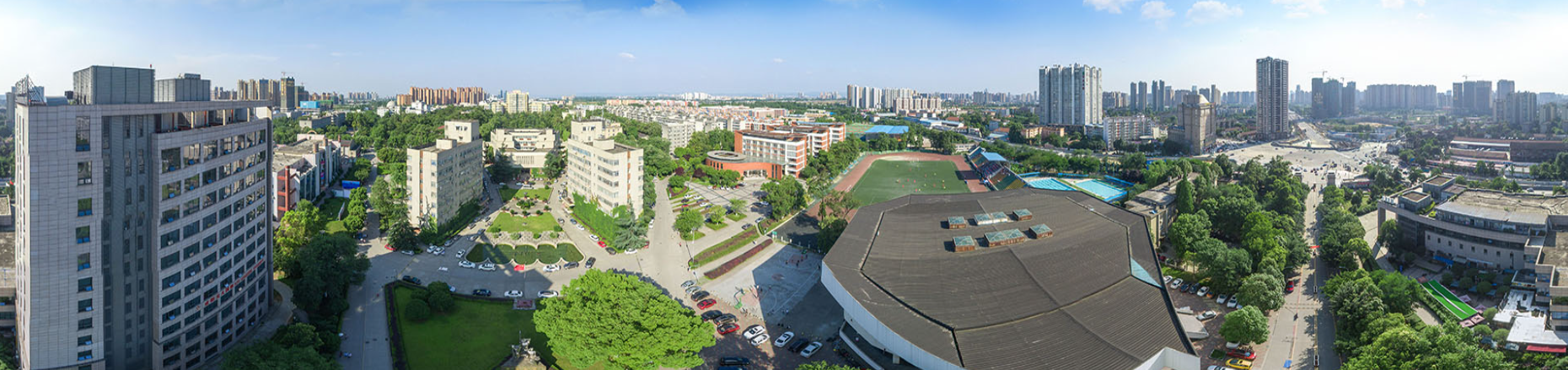
Recently, Professor Chao Li’s research team at the International Center for Sedimentary Geochemistry and Biogeochemistry Research, Chengdu University of Technology, published a significant study titled "Marine phosphorus and atmospheric oxygen were coupled during the Great Oxidation Event" in the international journal Nature Communications. This research, for the first time, employed the innovative proxy of Carbonate-Associated Phosphate (CAP) – a novel indicator capable of directly reflecting the phosphate content in ancient oceans (developed by Professor Li’s team, see Dodd et al., 2021, GCA) – to reveal the tight coupling between the oceanic nutrient phosphorus and atmospheric oxygen levels during Earth’s first Great Oxidation Event (GOE) approximately 2.4 to 2.1 billion years ago. This finding not only deepens our understanding of the origin and rise mechanisms of Earth’s oxygen but also provides a fresh perspective for exploring extraterrestrial habitable planets.
Approximately 2.4 to 2.1 billion years ago, the redox state of Earth’s surface underwent a historic transition. The atmospheric oxygen level rose significantly for the first time, marking Earth’s journey from an anoxic world to a stably oxygenated one – a process known as the GOE. However, how the GOE occurred and the source-sink controls of oxygen remain unclear. Through the lens of the marine phosphorus cycle, Professor Chao Li’s team, in collaboration with international scholars, combined CAP data with system models to provide answers.
The research team collected samples from carbonate rock formations across fourteen stratigraphic units on four continents, measuring their CAP content to track changes in global seawater phosphate concentration during the GOE. These strata record the prominent Lomagundi carbon isotope positive excursion, offering a unique window to examine the coupling between the marine phosphorus cycle, carbon cycle, and atmospheric oxygen. The results show a high degree of synchronicity between regional CAP values and carbonate carbon isotope (δ¹³Ccarb) changes during the GOE: when δ¹³Ccarbexhibited a positive shift (typically representing enhanced organic carbon burial and net oxygen accumulation), CAP values also increased significantly (Fig. 1). This indicates that elevated phosphorus levels in the ocean may have been a key factor driving the proliferation of photosynthetic organisms, promoting organic carbon burial, and ultimately leading to atmospheric oxygen accumulation.
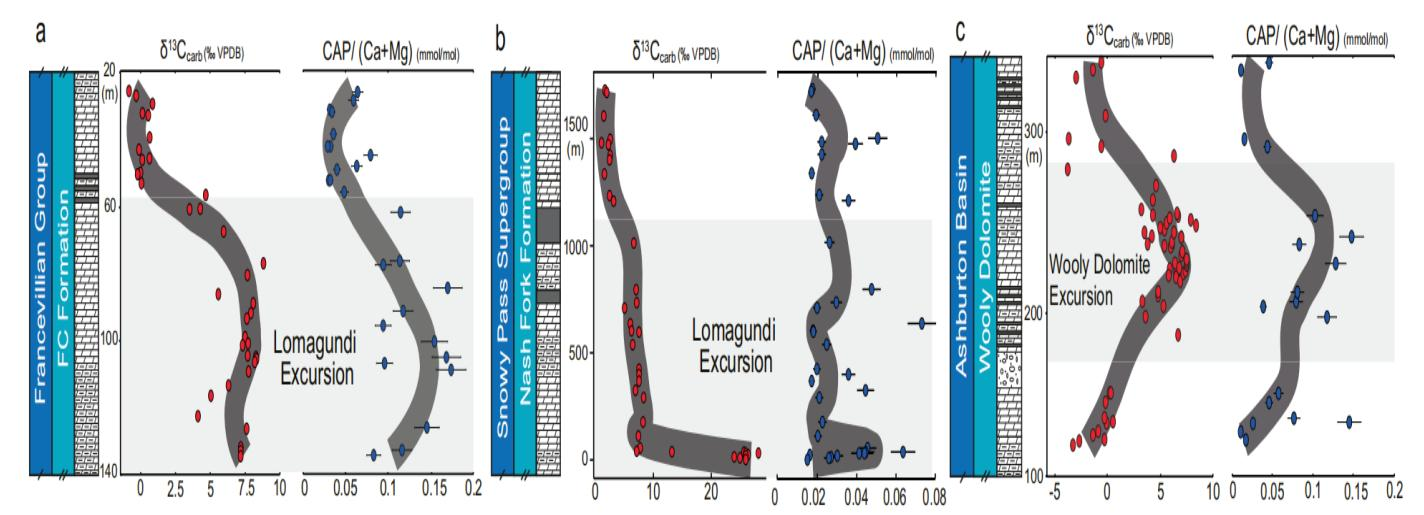
Fig.1 Secular trends in CAP values during the Lomagundi and Wooly Dolomite δ13C excursions. δ13C and CAP data for carbonate successions capturing the Lomagundi excursion at ca. 2100 million years ago from a the FC Formation, Gabon and b the Nash Fork Formation, Wyoming and c the Wooly Dolomite excursion, at ca. 2030 million years ago, from the Wooly Dolomite, Western Australia. Note that the high δ13Ccarb values are generally accompanied by the high CAP values. Dark grey lines represent locally weighted scatter plot smoothing. Error bars reflect the cumulative analytical error uncertainty of 10%. Light-grey boxes define carbonate carbon isotope excursions.
To verify this mechanism, the team further employed a four-box biogeochemical model (including "nearshore, outer shelf, pelagic surface, and pelagic deep waters") to simulate the impact of phosphorus input on marine carbon-oxygen cycling (Fig. 2). The model results align closely with the geological record: an enhanced phosphorus input to the ocean leads to a rapid rise in photosynthetic productivity and oxygen production, whereas a reduction in phosphorus supply causes a decline. Simulations confirm that the rise in atmospheric oxygen during the GOE was primarily driven by an oxygen source increase fueled by phosphorus, rather than a passive outcome of decreased reductant consumption.
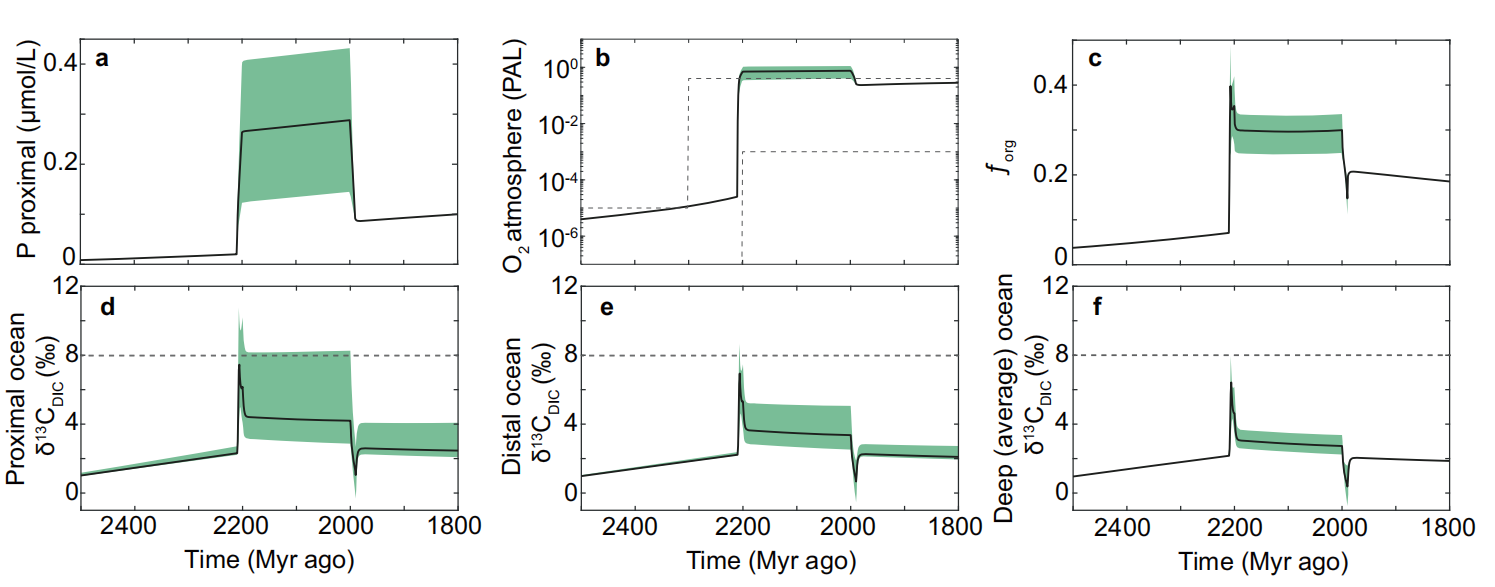
Fig. 2 Four-box biogeochemical model results. a P concentration in the proximal ocean box. b Atmospheric O2 concentration. c Fraction of inorganic carbon that is buried as organic carbon (forg). d, e Isotopic composition of DIC (δ13CDIC) in the proximal, distal and deep-ocean boxes. PAL present atmospheric level. DIC dissolved inorganic carbon. Green shading reflects model sensitivity range for 95% of results. Dashed grey lines in panel b indicate geochemical proxy evidence for atmospheric O2 level and average δ13Ccarb value for the Lomagundi Event.
"This is akin to injecting fuel into the Earth's surface system," explained Dr. Matthew Dodd, co-first author of the paper, a former postdoctoral fellow under Professor Li Chao and currently affiliated with the University of Western Australia. "In the early ocean, once phosphorus levels increased, the productivity of photosynthetic organisms and organic carbon burial enhanced significantly. As more organic carbon was sequestered, oxygen could accumulate freely in the atmosphere – this is the process of Earth taking its first 'deep breath'."
"Oxygen is fundamental for the existence of complex life," noted Professor Chao Li. "This study not only unveils how the phosphorus cycle propelled the rise of Earth’s oxygen but also provides crucial insights for astrobiology. In the search for extraterrestrial habitable planets, an oxygen-rich atmosphere is often considered a potential biomarker. The 'phosphorus-oxygen coupling mechanism' we propose clearly delineates the path of oxygen production and accumulation on a habitable planet, offering a new theoretical framework for interpreting oxygen detection data from exoplanets."
In conclusion, this work represents a significant advancement in the study of early Earth’s environment and life evolution. It demonstrates that Earth’s surface oxidation process was not merely a single chemical reaction but an 'ecological revolution' jointly driven by nutrient supply, biological activity, and Earth system feedback. Although details regarding phosphorus-driven Earth oxidation require further exploration, this study undoubtedly lays a solid foundation for unraveling the mystery of Earth’s 'oxygen rise'.
Publication Information
Dodd, M.S., Li, C., Gu, H., Zhang, Z., Hou, M., Sadekov, A., Rosiere, C.A., Pirajno, F., Alcott, L., Ossa Ossa, F., Mills, B.J.W., & Bekker, A. (2025). Marine phosphorus and atmospheric oxygen were coupled during the Great Oxidation Event. Nature Communications, 16(1): 1-12.
Article Link: https://doi.org/10.1038/s41467-025-64194-4
This achievement features Professor Chao Li from Chengdu University of Technology and Dr. Matthew Dodd from the School of Earth and Ocean Sciences, University of Western Australia (flexibly introduced talent at the Center) as co-first authors and corresponding authors. Professor Mingcai Hou and Dr. Zihu Zhang from Chengdu University of Technology are co-authors.