A recent study published in the journal Geology reveals a new mechanism for the prolonged ocean anoxia during the late Cambrian SPICE event. The research, led by Dr. Meng Cheng from Professor Chao Li’s team at Chengdu University of Technology, employs a novel combination of geochemical proxies to demonstrate that intensified oceanic phosphorus recycling, driven by expanding seafloor euxinia, sustained the multimillion-year anoxic episode.
1. Research Background
The late Cambrian Steptoean Positive Carbon Isotope Excursion (SPICE) is one of the most significant carbon isotope excursions in Earth's history, lasting approximately 2-3 million years. It coincided with the end-Marjuman trilobite extinction and a globally widespread episode of ocean euxinia (anoxic and sulfidic conditions). While enhanced organic carbon burial under euxinia is implicated in the carbon cycle perturbation, the mechanism sustaining such prolonged redox conditions has remained unclear. Phosphorus, the ultimate limiting nutrient for primary productivity on geological timescales, plays a crucial role. Its oceanic inventory depends not only on continental input but also critically on internal recycling processes. Understanding phosphorus cycling is therefore key to deciphering the driving forces behind the SPICE event.
2. Key Findings
To investigate the sustaining mechanism, the research team analyzed four drill cores from different depositional environments (deep basin to platform edge) within the central Missouri intrashelf basin, Laurentia. They systematically applied the I/(Ca+Mg) ratio (a proxy for shallow-water redox conditions) and the Carbonate-Associated Phosphorus (CAP) method (a proxy for seawater phosphate availability) developed previously by Professor Chao Li's team (see Figure 1 for key geochemical data from the four sections).
The results show:
(1) Significantly Increased Phosphorus Availability during SPICE: CAP values increased markedly during the SPICE interval, moving in parallel with the positive shift in δ¹³C. This indicates a substantial rise in phosphate levels in the surface ocean.
(2) Persistent Low-Oxygen Conditions in Shallow Seas: I/(Ca+Mg) ratios remained consistently low, corresponding to low dissolved oxygen concentrations (<20–70 μM), indicating that shallow waters were persistently oxygen-poor before, during, and after the SPICE.
(3) Proposal of a "Phosphorus Recycling-Anoxia Positive Feedback Mechanism" (see Figure 2): Integrated with quantitative modeling, the study proposes a self-reinforcing feedback loop. The expansion of seafloor euxinia under initially cool conditions led to: reduced iron oxide formation → decreased efficiency of phosphorus sequestration into sediments, enhancing its release back into the water column; upwelling transported this recycled phosphorus to the surface ocean → stimulated primary productivity; increased organic matter export to depth → intensified oxygen consumption in deeper waters, reinforcing euxinia. This closed loop maintained the ocean's sulfidic state for millions of years until increasing atmospheric O2 levels eventually ventilated the deep ocean and terminated the event.
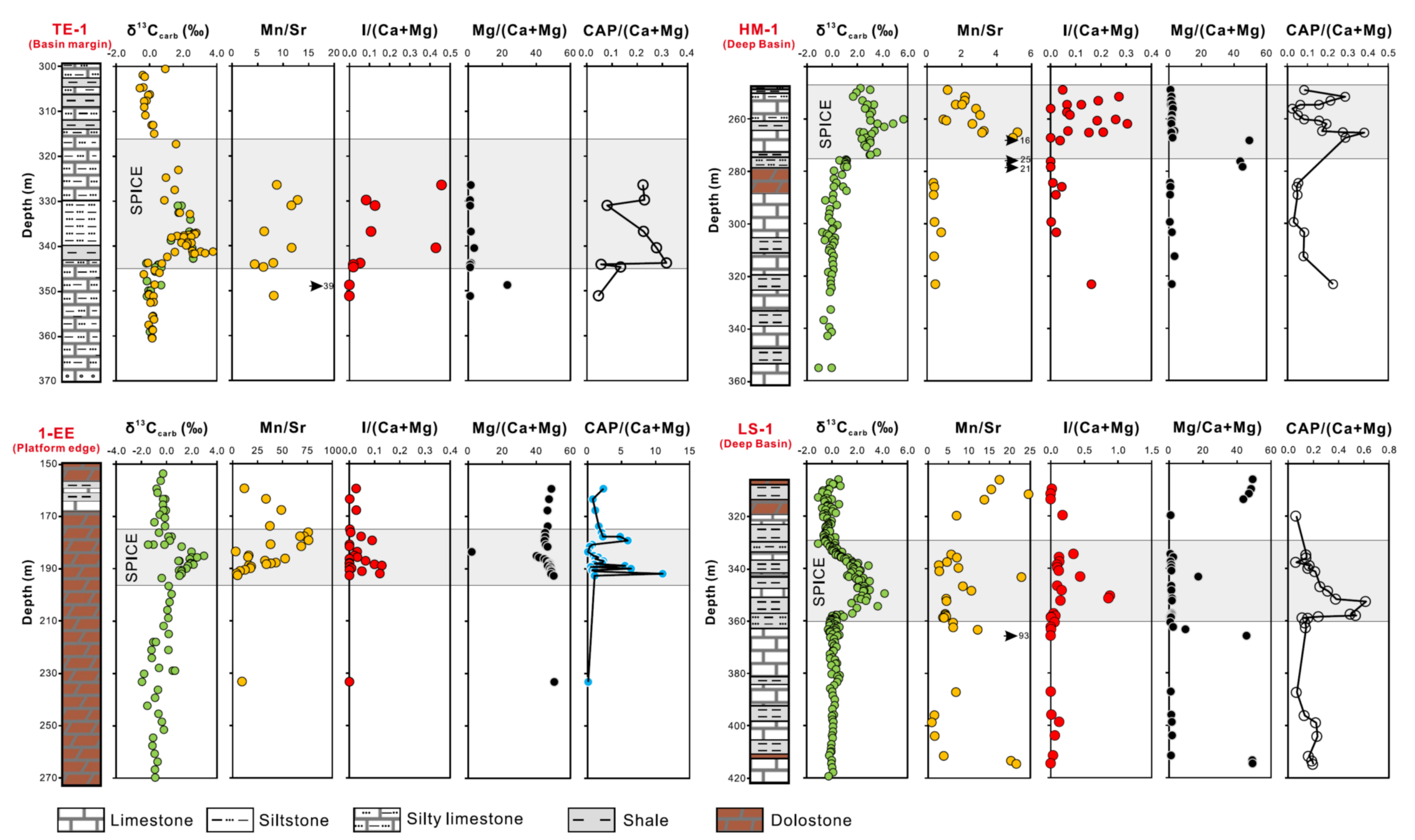
Figure 1. Key geochemical data (CAP, I/[Ca+Mg], δ¹³C) from the four study sections
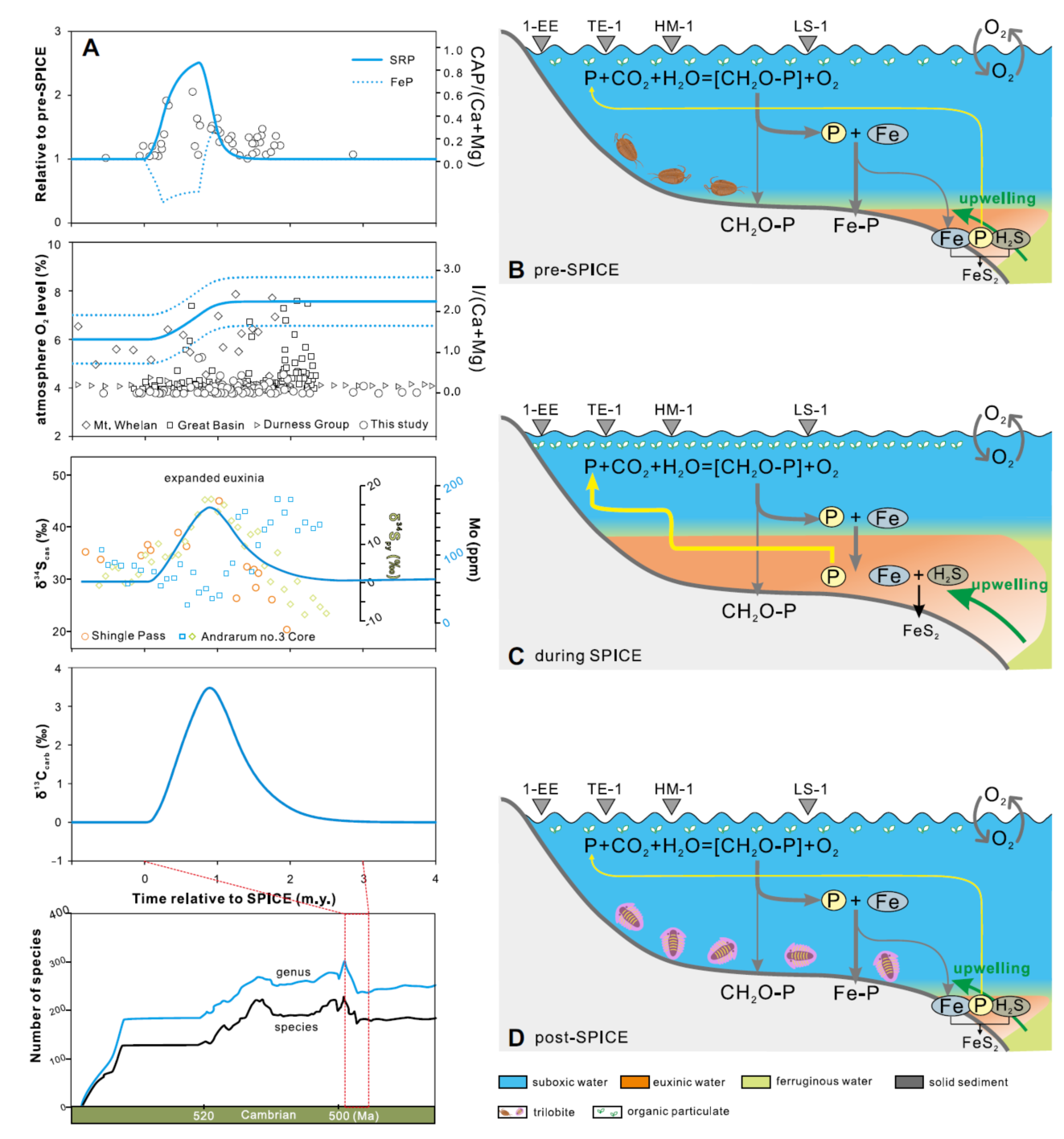
Figure 2. Quantitative (A) and qualitative (B-D) relationships between ocean redox state, phosphorus cycling, primary productivity, and biological evolution before, during, and after the SPICE event
3. Research Significance
This study provides a crucial explanation for the long duration of the SPICE event from an "internal oceanic cycling" perspective. First, it identifies enhanced phosphorus recycling as a core mechanism driving environmental changes in the late Cambrian ocean, offering new evidence for understanding how nutrient cycles control ancient ocean chemistry. Second, it reveals a strong coupling between the phosphorus cycle and ocean redox state, demonstrating that euxinic conditions can promote phosphorus recycling, which in turn reinforces anoxia—a mechanism with potential implications for explaining other Phanerozoic oceanic anoxic events. Finally, it provides a new perspective for understanding the interaction between biological evolution and environmental change during the Cambrian. For instance, enhanced productivity and organic flux likely impacted deep-water ecosystem structure and biodiversity. Overall, this work establishes a key Earth system feedback mechanism—"euxinia drives phosphorus recycling → phosphorus boosts productivity → productivity exacerbates deep-water anoxia"—deepening our understanding of Cambrian ocean redox instability and life-environment co-evolution.
Authors and Funding
Dr. Meng Cheng is the first author. Dr. Meng Cheng, Associate Researcher Junpeng Zhang (Nanjing Institute of Geology and Palaeontology, CAS), and Professor Chao Li are the corresponding authors. Collaborators include researchers from Chengdu University of Technology, University of Missouri, Nanjing University, University of Western Australia, U.S. National Park Service, and University of Cincinnati.
This research was supported by the National Key Research and Development Program of China and projects from the National Natural Science Foundation of China.
Paper Information: Cheng, M., Zhang, J., Schiffbauer, J.D., Zhang, Z., Wang, H., Cao, M., Li, N., Dodd, M.S., Pulsipher, M.A., Algeo, T.J., Hou, M., Li, C., 2026. Enhanced oceanic phosphorus recycling during the Cambrian SPICE event. Geology. https://doi.org/10.1130/G54063.1