A breakthrough study published in Sedimentology offers unprecedented mineralogical insights into the dynamic marine conditions of the early Cambrian—a pivotal era marked by the explosion of complex life. Conducted by Ph.D. candidate Hui Song under Professor Chao Li at Chengdu University of Technology, the research establishes, for the first time, a direct connection between nanoscale mineral microstructures and high-frequency oceanic oxygenation events. This discovery provides a new lens through which to examine the co-evolution of early life and its environmental context.
1. Research Background
The early Cambrian represents a pivotal chapter in Earth’s history, marked by the rapid diversification of complex life during the “Cambrian Explosion.” However, a paradox persists: widespread black shales and many geochemical proxies indicate that oceans were largely anoxic—conditions seemingly inhospitable to aerobic animals. Yet, well-preserved sponge spicules, which require oxygen, are found within these same anoxic layers. This discrepancy points to brief, transient pulses of oxygenation that may elude detection by conventional geochemical proxies due to their limited temporal resolution. Resolving the nature and rhythm of these high-frequency redox fluctuations is therefore crucial to deciphering the environmental triggers of the Cambrian Explosion.
2. Key Discoveries
The research team examined a continuous ~100-meter core (LX03) from the Lower Cambrian Shuijingtuo Formation black shales in the Yichang area (see Figure 1). Using advanced techniques—including scanning electron microscopy (SEM) and spherical aberration-corrected transmission electron microscopy (ACTEM)—they systematically characterized sedimentary framboidal pyrite at nanometer to atomic scales.
The study's major breakthrough is the first discovery of framboidal pyrite microcrystals with distinct, irregularly serrated margins in specific thin layers (mm- to cm-thick) within the shale (see Figures 2 & 3 for microscopic images). High-resolution analysis revealed critical details:
Passivation Layer: Some serrated edges are enclosed within an ~5-nm-thick amorphous film rich in iron and oxygen, identified as a passivation layer formed during initial oxidation.
Oxidation Byproducts: Atomic-scale phase identification confirmed the presence of oxidation products like marcasite (FeS₂), ferrous sulfate (FeSO₄), and iron sulfate hydrate (FeSO₄·nH₂O) alongside pyrite, providing direct evidence for localized oxidative dissolution.
A Two-Stage Oxidation Model: The team proposed a new model for pyrite oxidation in ancient sediments. It is not a simple linear process but involves two distinct stages (see Figure 3 for the model): 1) Formation of a protective passivation layer at moderate redox potential, slowing further oxidation; 2) Breakdown of this layer and formation of the characteristic serrated structures under higher redox potential, indicating a stronger oxidation pulse.
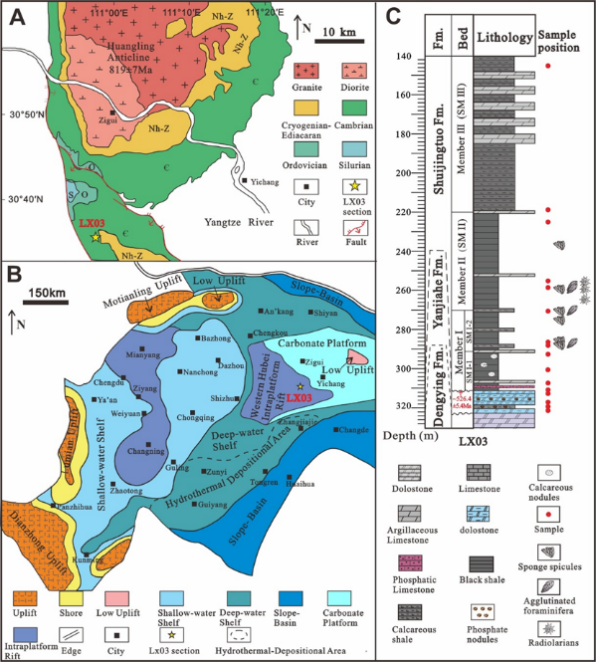
Figure 1. Location map of the study area and core column. (A) Geological sketch map of the Yichang area, western Hubei Province, China (modified from Liu et al., 2022; Zhang et al., 2022); (B) Paleogeographic map of the Yangtze Platform during the Early Cambrian (modified from Zhao et al., 2019; Algeo & Li, 2026); (C) Lithostratigraphic column of the LX03 drill core (fossil distribution based on Zhang et al., 2022; the SIMS U-Pb age of 526.4 ± 5.4 Ma at the base of the Shuijingtuo Formation is from Okada et al., 2014).
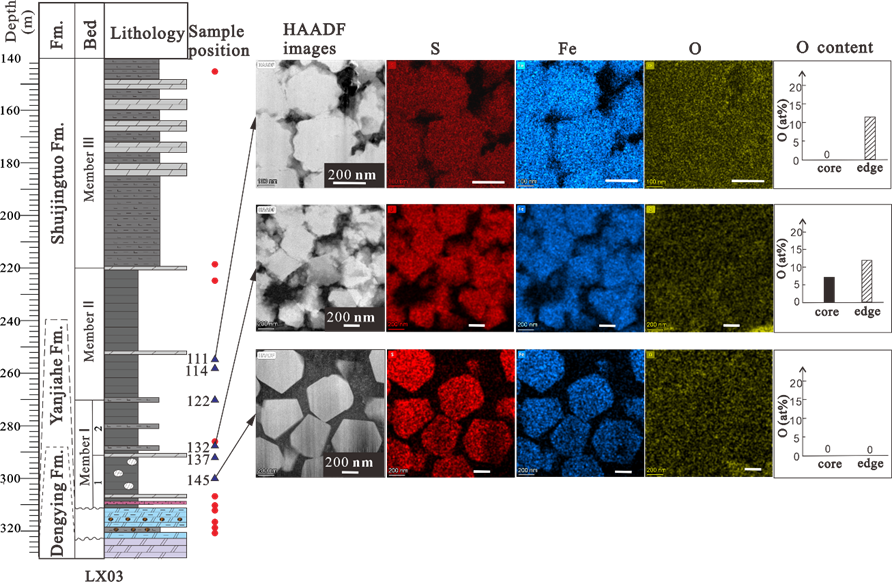
Figure 2. Serrated microstructures and STEM elemental mapping of representative samples from the Lower Cambrian Shuijingtuo Formation in the LX03 drill core..
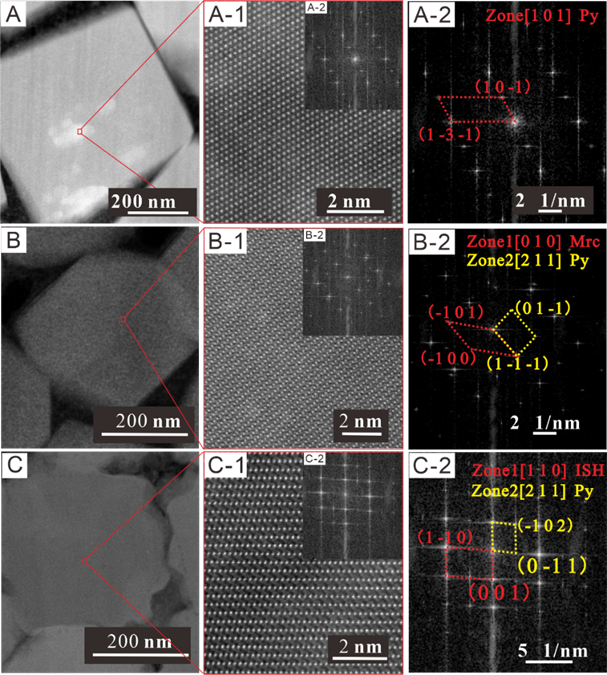
Figure 3. HRSTEM mapping of representative samples from the Lower Cambrian Shuijingtuo Formation in the LX03 drill core. (A) LX-145, depth 298.87 m; (B) LX-114, depth 256.63 m; (C) LX-111, depth 252.31 m. Py: Pyrite (FeS₂); Mrc: Marcasite (FeS₂); ISH: Iron Sulfate Hydrate (FeSO₃·(H₂O)₃).
3. Research Significance
By ruling out effects from modern weathering and sample processing, the study confirms these nanostructures are primary records of syn-depositional to early diagenetic redox conditions. The stratigraphic distribution of these serrated pyrite microcrystals shows a high spatiotemporal coupling with occurrences of benthic fossils like sponge spicules and foraminifera (see Figure 4).
By excluding the influence of modern weathering and sample processing artifacts, the study confirms that these nanostructures constitute primary archives of syn-sedimentary to early diagenetic redox conditions. Notably, the stratigraphic distribution of the serrated pyrite microcrystals exhibits a marked spatiotemporal correlation with the occurrence of benthic fossils, such as sponge spicules and foraminifera (see Figure 4).
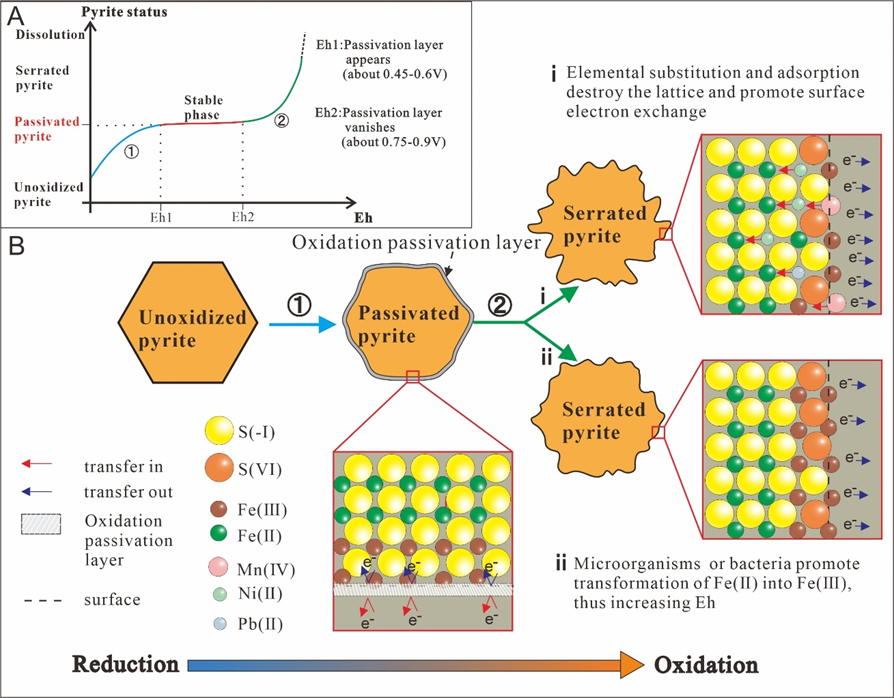
Figure 4. Conceptual model of pyrite oxidation process. (A) Two stages of pyrite oxidation; (B) Micro-scale simulation of serrated structure formation.
This coupling provides direct mineralogical evidence for pulsed bottom-water oxygenation events in the early Cambrian anoxic ocean. The study posits that these high-frequency, low-intensity oxygen pulses created temporary habitable niches for early complex life on the seafloor while simultaneously initiating the nano-serration of pyrite before conditions returned to anoxia. This dynamic, fluctuating redox model explains how aerobic life could persist in generally anoxic settings and highlights how rapid redox oscillations may have enhanced fossil preservation potential.
In summary, this work establishes a direct link between nanoscale mineral textures and paleo-oceanographic processes. It pioneers a new methodological approach for investigating high-frequency redox dynamics in ancient oceans and provides crucial evidence for understanding the complex environmental context that fostered the dawn of animal life.
Authors and Funding
Ph.D. candidate Hui Song is the first author. Professor Tongwei Zhang (University of Texas at Austin) and Professor Chao Li (Chengdu University of Technology) are the corresponding authors. Collaborators include researchers from the University of Cincinnati, Northwest University, PetroChina Changqing Oilfield Company, and Yichang Chengfa Energy Company Limited.
This research was supported by the National Key Research and Development Program of China and the National Natural Science Foundation of China.
Paper Information: Song, H., Zhang, T., Algeo, T.J., Meng, K., Shao, D., Zhang, Y., Li, C. (2026). Nanoscale serrated framboidal pyrite documents pulsed bottom-water oxygenation in the early Cambrian anoxic ocean. Sedimentology. https://doi.org/10.1111/sed.70099.